
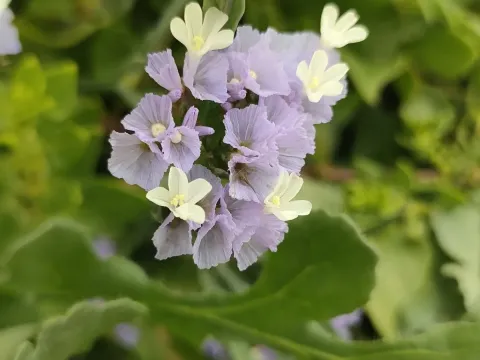
Statice
Limonium Mill.
Statice seeds are relatively small and encased in a tough hull, which is why pre-sowing treatment or soaking can improve germination rates. In professional cultivation, seeds are sown in plug trays during late winter or early spring to ensure strong root development before transplanting.
What the section contains
 Caspian statice
Limonium bellidifolium x Limonium gerberi
Caspian statice
Limonium bellidifolium x Limonium gerberi
 Chinese statice
Limonium sinense (Girard) Kuntze
Chinese statice
Limonium sinense (Girard) Kuntze
 Gmelin sea lavender
Limonium gmelinii (Willd.) Kuntze
Hybrid Statice
Limonium perigrinum x l purpuratum hybrid
Gmelin sea lavender
Limonium gmelinii (Willd.) Kuntze
Hybrid Statice
Limonium perigrinum x l purpuratum hybrid
 Hybrid Statice
Limonium sinense x Limonium sinuatum
Hybrid Statice
Limonium sinense x Limonium sinuatum
 Limonium altaica
Limonium altaica
Limonium altaica
 Limonium bellidifolium
 (Gouan) Dumort.
Limonium bellidifolium
Limonium bellidifolium (Gouan) Dumort.
 Limonium bonduellei
 (T. Lestib.) Kuntze
Limonium bonduellei
Limonium bonduellei (T. Lestib.) Kuntze
 Limonium gerberi
 Soldano
Limonium gerberi
Limonium gerberi Soldano
 Limonium puberulum
 (Webb) Kuntze
Limonium puberulum
Limonium puberulum (Webb) Kuntze
 Perez sea lavender hybrid
Limonium perezii (Stapf) F. T. Hubb. x L. sinuatum (L.) Mill
Perez's sea lavender
Limonium perezii (Stapf) F. T. Hubb.
Perez's Statice
Limonium puberulum (Webb) Kuntze x Limonium perezii (Stapf) F. T. Hubb.
Perez sea lavender hybrid
Limonium perezii (Stapf) F. T. Hubb. x L. sinuatum (L.) Mill
Perez's sea lavender
Limonium perezii (Stapf) F. T. Hubb.
Perez's Statice
Limonium puberulum (Webb) Kuntze x Limonium perezii (Stapf) F. T. Hubb.
 Purple Statice
Limonium purpuratum
Purple Statice
Limonium purpuratum
 Statice
Limonium sinuatum (L.) Mill.
Statice
Limonium sinuatum (L.) Mill.
 Wandering sea-lavender
Limonium peregrinum (P. J. Bergius) R. A. Dyer
Wandering sea-lavender
Limonium peregrinum (P. J. Bergius) R. A. Dyer
Statice
Sowing depth should be approximately 0.5 to 1 centimeter in a high-quality, well-draining peat-based substrate. Maintaining a consistent temperature of 20°C (68°F) is critical during the two-week germination window.
Direct seeding in the field is only recommended in frost-free regions. When sowing directly, ensure that the soil is warmed up sufficiently to prevent seed decay caused by cold, wet conditions in early spring.
Transplanting should be done carefully as Statice produces a long taproot that dislikes disturbance. Once the seedlings reach a stage with 3–4 true leaves, they are ready to be hardened off and moved to their permanent location.
Proper spacing is essential for air circulation, which significantly impacts the incidence of fungal diseases. A spacing of 30x40 centimeters is usually sufficient to maintain healthy growth and optimal yield per square meter.
Statice (Limonium Mill.) is a member of the Plumbaginaceae family, native to Mediterranean and steppe regions. It thrives in full sunlight, which is an absolute requirement for the development of vivid, colorful calyces that represent the crop's decorative value.
The crop prefers sandy or loamy soils with excellent drainage. It is highly intolerant of waterlogged soil, which causes rapid root rot and wilting. Ensuring the site is slightly elevated helps mitigate drainage issues.
Statice is remarkably drought-tolerant once established. While it appreciates moderate watering during its active growth phase, it should be protected from excessive rainfall, especially during the harvest period.
Regarding soil fertility, Statice does not require heavy nitrogen feeding. Over-fertilization results in lush foliage but delays flowering and weakens the quality of the floral stems, making them less suitable for commercial use.
The optimal soil pH for Statice ranges from neutral to slightly alkaline. In acidic soil conditions, incorporating lime or wood ash can help stabilize the environment and improve the plant's overall health.
Commercial yield is calculated by the number of high-quality, marketable flower stems harvested per growing season. A well-managed plot can produce several thousand stems per hectare over the course of the summer months.
The yield potential is influenced by the variety chosen and the timing of the initial planting. Modern hybrids often provide more uniform stem length and superior color intensity, which increases the crop's market value.
Continuous harvesting throughout the summer stimulates the plant to push out new shoots, thereby extending the production window. Proper moisture management during this time is key to ensuring consistent stem quality.
Post-harvest grading is a vital part of the yield process. Stems are sorted by length, color uniformity, and freedom from mechanical damage or disease. Quality control standards are essential for entering premium floral markets.
Effective crop rotation practices significantly influence yield over time. Avoid planting Statice in the same field for consecutive years to minimize the buildup of soil-borne pathogens and nutrient depletion.
Grey mold, caused by the fungus Botrytis, is the primary threat to Statice, especially under conditions of high humidity or poor ventilation. Early detection and removing infected leaves are essential for disease control.
Powdery mildew may appear on the foliage during periods of fluctuating temperatures. Fungicide applications should be timed correctly, targeting the early stages of infection to protect the developing inflorescences.
Aphids can be particularly problematic as they congregate on the flower buds and tender stems, sucking sap and causing deformity. Integrated pest management using beneficial insects or selective insecticides is recommended.
Root rot is often the result of poor soil preparation or over-watering. If the planting site lacks sufficient drainage, the plants are highly susceptible to root-related diseases that can wipe out entire sections of the crop.
A proactive protection strategy includes keeping the base of the plant clear of debris and ensuring the field is kept weed-free to promote airflow, which effectively reduces the reliance on heavy chemical treatments.
The timing of harvest is crucial for the quality of dried flowers. Stems should be cut when the florets are fully open but before they begin to fade or drop their petals, as this ensures maximum durability.
Harvesting is best performed during the cool early morning hours when the plant's turgor pressure is high. This prevents the stems from wilting prematurely and maintains their structural integrity for drying.
After cutting, the flowers should be bundled and hung upside down in a dark, dry, and well-ventilated area. Darkness is essential because exposure to sunlight during the drying process causes color bleaching.
Drying usually takes two to three weeks depending on the relative humidity. Once fully dried, the stems should be stored in a cool, moisture-free environment to prevent the reabsorption of humidity and mold formation.
Proper harvest techniques, including using clean, sharp tools, reduce plant stress and keep the production healthy. High-quality dried Statice retains its aesthetic appeal for years if stored correctly.