
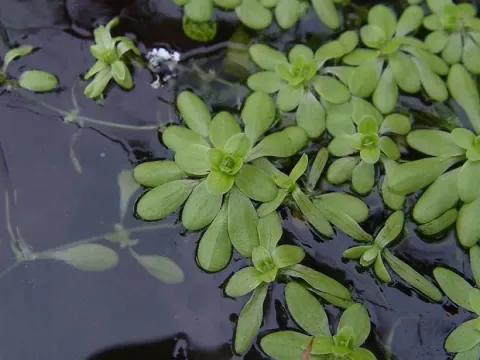
Starwort
Callitriche
Starwort (Callitriche) is a genus of aquatic plants belonging to the Plantaginaceae family. These plants are found in various aquatic habitats worldwide, ranging from shallow ponds and ditches to slow-moving streams, demonstrating high environmental plasticity.
What the section contains
 Autumn water-starwort
Callitriche hermaphroditica
Autumn water-starwort
Callitriche hermaphroditica
 Blunt-fruited water-starwort
Callitriche obtusangula
Blunt-fruited water-starwort
Callitriche obtusangula
 Callitriche cribrosa
Callitriche cribrosa
Callitriche cribrosa
 Callitriche deflexa
Callitriche deflexa
Callitriche deflexa
 Callitriche lusitanica
Callitriche lusitanica
Callitriche lusitanica
 Callitriche muelleri
Callitriche muelleri
Callitriche muelleri
 Callitriche naftolskyi
Callitriche naftolskyi
Callitriche naftolskyi
 Callitriche peploides
Callitriche peploides
Callitriche peploides
 Callitriche petriei
Callitriche petriei
Callitriche petriei
 Callitriche truncata
Callitriche wightiana
Callitriche wightiana
Callitriche truncata
Callitriche truncata
Callitriche wightiana
Callitriche wightiana
 Hooked water-starwort
Callitriche hamulata
Hooked water-starwort
Callitriche hamulata
 Japanese water-starwort
Callitriche japonica
Japanese water-starwort
Callitriche japonica
 Pedunculate water-starwort
Callitriche brutia
Soft-furrowed water-starwort
Callitriche lenisulca
Pedunculate water-starwort
Callitriche brutia
Soft-furrowed water-starwort
Callitriche lenisulca
 Terrestrial starwort
Callitriche terrestris
Terrestrial starwort
Callitriche terrestris
 Water starwort
Callitriche cophocarpa
Water starwort
Callitriche cophocarpa
 Water starwort
Callitriche palustris
Water starwort
Callitriche palustris
 Water starwort
Callitriche platycarpa
Water starwort
Callitriche platycarpa
 Water starwort
Callitriche stagnalis
Water starwort
Callitriche stagnalis
 Water starwort
Callitriche regis-jubae
Water starwort
Callitriche regis-jubae
Starwort
The botanical structure of Starwort is defined by slender stems and opposite leaves that often cluster into distinct rosettes at the water surface. This structure maximizes photosynthetic efficiency, allowing the plant to thrive in diverse water depths.
The cultural requirements for Callitriche focus on water quality and substrate stability. The plant prefers silt or fine sandy bottoms where it can anchor its fibrous root system to extract nutrients efficiently from the sediment.
In terms of light and temperature, Starwort is highly adaptable but performs best in cool to moderate temperatures. It acts as an excellent oxygenator for water bodies, maintaining a healthy dissolved oxygen balance for aquatic fauna.
Practically, Starwort is widely used in water gardens and ecological restoration projects. Its ability to absorb nutrients and filter particulates makes it an essential tool for managing water quality in closed aquatic systems and nurseries.
The main threats to Starwort involve chemical contamination, particularly from agricultural runoff. Pesticides and excessive herbicides significantly impair the physiological functions of the plant, often leading to necrosis.
Aquatic pests, such as snails and certain beetle larvae, can cause significant foliar damage. In dense populations, these pests can strip the leaves, which eventually leads to the depletion of the plant's carbohydrate reserves.
Fungal pathogens and water molds represent a significant risk, especially in stagnant or poorly ventilated water bodies. High organic matter levels in the water column promote the growth of these pathogens, causing stem rot.
Competition from aggressive algae and invasive aquatic weeds is a persistent challenge. Invasive species can quickly outcompete Starwort for light and space, causing a rapid decline in the population density of the culture.
Effective management requires maintaining consistent water parameters and limiting the inflow of nutrients that favor algal blooms. Regular physical inspection and removal of contaminated debris help to keep the crop healthy and productive.