
Callitriche cribrosa
Callitriche cribrosa
Description
Growing requirements
Callitriche cribrosa, commonly known as a type of water starwort, is an annual aquatic plant belonging to the Plantaginaceae family. It is primarily observed in freshwater ecosystems, serving as a significant component of the aquatic vegetation in shallow water bodies.
The distribution of this species spans across various Eurasian regions, where it thrives in stagnant or slow-moving water. It is commonly found in ditches, small ponds, and marshy depressions that provide a stable environment during the growing season.
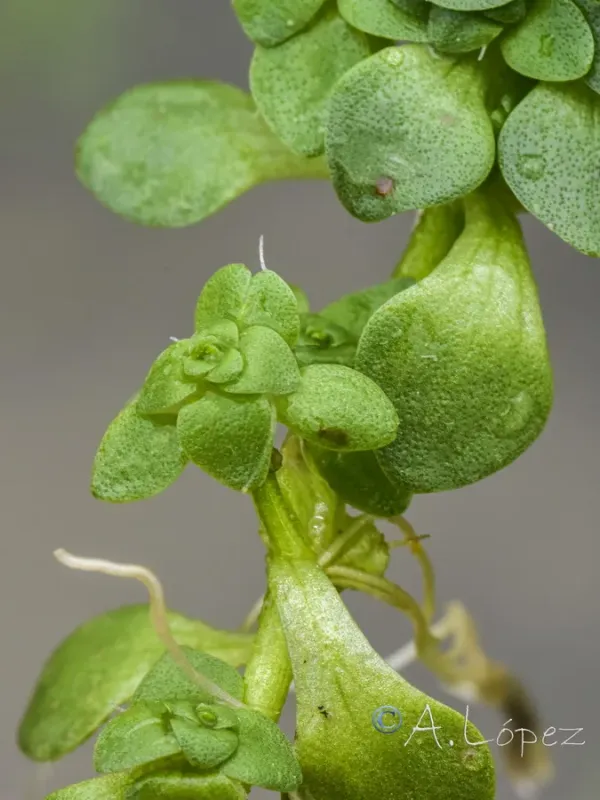
Botanically, the plant is characterized by a slender stem with opposite leaves. The morphology changes depending on the depth: submerged leaves are linear and translucent, while floating leaves form distinct rosettes on the water surface, facilitating photosynthesis.
Light intensity is a critical factor for the growth of Callitriche cribrosa. The species requires well-lit conditions to maintain the structural integrity of its rosettes and to support the energy-intensive process of flower and seed production.
Soil requirements are relatively modest, as the plant relies heavily on nutrient absorption from the water column. However, a nutrient-rich silty substrate provides the necessary anchorage for the fragile root system to withstand minor water disturbances.
Main diseases and pests
Pathogenic fungi are the primary biological threat to the species, often attacking the stems in stagnant waters with poor circulation. These infections can lead to rapid decay and loss of vegetative biomass throughout the entire population.
Pests such as aquatic snails and certain larvae of insects frequently feed on the succulent leaves of the plant. Significant grazing pressure can lead to a reduction in the plant's ability to store energy for the reproductive phase.
Environmental degradation remains the most severe threat. Eutrophication, caused by agricultural runoff, leads to excessive algal blooms that block sunlight and deplete dissolved oxygen, making it impossible for the starwort to survive.
The use of chemical herbicides in proximity to water bodies creates toxic conditions that prevent the germination of Callitriche cribrosa seeds. This chemical stress affects the entire life cycle, often leading to localized extinction.
Physical disturbances, including drainage of ponds and dredging of irrigation channels, disrupt the habitat. As an annual, the species relies on the seed bank in the soil; constant mechanical interference prevents the successful completion of its life cycle.