
Water starwort
Callitriche stagnalis
Description
Growing requirements
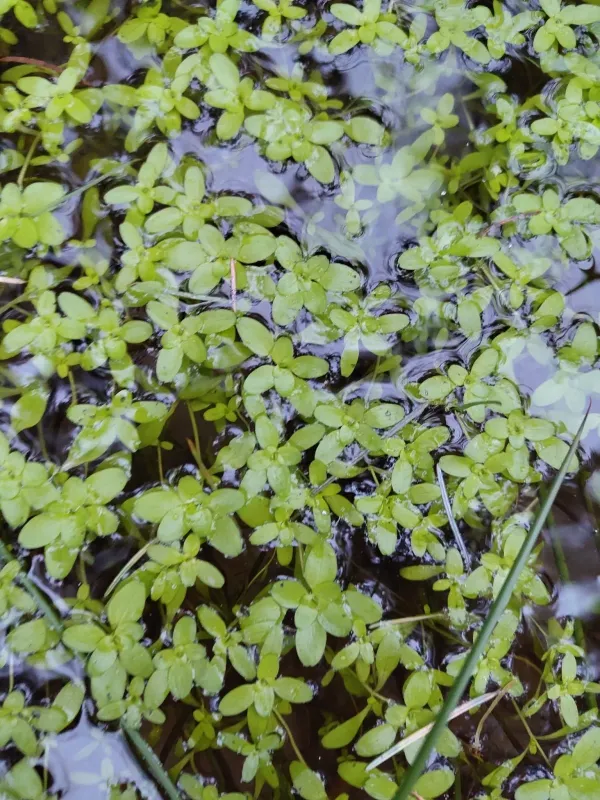
Water starwort (Callitriche stagnalis) is an annual or perennial aquatic herb belonging to the Plantaginaceae family. Originally native to Europe, North Africa, and parts of North America, it thrives in stagnant or slow-moving freshwater environments, including ponds, ditches, and muddy banks that stay consistently moist.
The plant exhibits remarkable botanical adaptations, specifically dimorphic leaves. It produces thin, linear leaves when fully submerged and develops dense, bright green, spoon-shaped leaves in rosettes on the water surface. This dual-leaf structure is essential for oxygen exchange and light absorption in diverse water depths.
In terms of growth requirements, this species favors calm, nutrient-rich water with a neutral pH level. While it prefers full sun to partial shade, it is highly adaptable to various lighting conditions, making it a popular choice for both naturalistic garden ponds and controlled aquatic environments like tanks or small water features.
Cultivation practices involve placing the plant in a silty or sandy substrate that allows the roots to anchor firmly. It is relatively easy to maintain but requires periodic thinning in smaller ponds to ensure it does not completely dominate the surface area, which could otherwise limit light penetration for other aquatic life.
Economically, the plant is primarily utilized for water remediation. Due to its rapid growth rate, it effectively absorbs excess nitrates and phosphates from the water column, acting as a natural biological filter that helps suppress algae blooms and keeps the water clear and oxygenated for fish and other organisms.
Main diseases and pests
The most common threats to healthy development include infestation by filamentous algae which can smother the surface rosettes, and the risk of fungal infections such as leaf spot if water circulation is stagnant for extended periods. Common invertebrate pests, including snails and certain aphids, may graze on the soft foliage, potentially reducing the overall ornamental quality of the planting.