
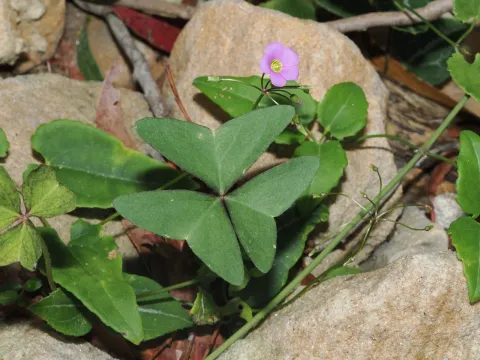
Pink woodsorrel
Oxalis latifolia
Pink woodsorrel (Oxalis latifolia) is a perennial herbaceous plant belonging to the Oxalidaceae family. Native to tropical and subtropical regions of the Americas, it has successfully established itself as an invasive species in various parts of the world.
What the section contains
Pink woodsorrel
The plant is biologically distinguished by its complex system of underground bulbs, which allow it to survive adverse conditions and propagate vegetatively with extreme efficiency. Its leaves are distinctively tripartite with broad, wedge-shaped segments.
Regarding its requirements, the species thrives in warm, temperate climates and prefers well-drained, nutrient-rich soils. While it is adaptable, it is most invasive in cultivated areas such as gardens and agricultural fields where soil moisture is maintained.
Agrotechnical management is essential due to the plant's aggressive growth pattern. Farmers are encouraged to focus on early identification, as once the bulb population becomes dense, eradication becomes significantly more difficult.
While the plant holds minimal agricultural value, it is sometimes noted for its ornamental value in controlled environments. However, in broad-scale farming, it is classified as a troublesome weed that compromises the yield of primary crops.
Major threats to Oxalis latifolia populations include various fungal pathogens, particularly those causing leaf spots or rust, which are often exacerbated by high humidity levels and poor field ventilation.
Insects rarely pose a significant threat to the plant because the high concentration of oxalates acts as a natural deterrent against most generalist herbivores and agricultural pests.
Mechanical cultivation remains a risky strategy; if not executed properly, it can break apart the bulb clusters, resulting in the dispersal of plant material and an unintended increase in population density.
Chemical control strategies typically rely on systemic herbicides that are capable of translocating through the foliage down to the bulbs to ensure total mortality of the underground storage organs.
Integrated weed management remains the best practice for suppressing this species, combining consistent monitoring with targeted herbicide application and crop rotation to limit the space available for its proliferation.