
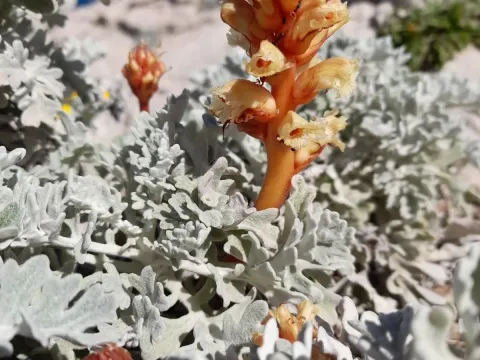
Orobanche fuliginosa
Orobanche fuliginosa
Orobanche fuliginosa is a species belonging to the Orobanchaceae family. It is a holoparasitic plant, meaning it entirely lacks chlorophyll and obtains its water, mineral nutrients, and carbohydrates through specialized root structures known as haustoria.
What the section contains
Orobanche fuliginosa
The plant is native to the Mediterranean region and parts of Southern Europe. It thrives in open, rocky, or sandy habitats where its specific host plants are present, typically favoring well-drained soils that allow for gas exchange in the rhizosphere.
Morphologically, it displays a characteristic upright, succulent stem that emerges above ground during the flowering season. Its leaves are reduced to small scales, and its root system is rudimentary, having evolved to function exclusively as an attachment organ.
The germination of seeds is strictly regulated by chemical signals released from the roots of the host plant. If these signals are absent, the seeds remain dormant in the soil, sometimes maintaining viability for over a decade in the seed bank.
Environmental conditions such as soil temperature and moisture levels must align with the physiological requirements of both the host and the parasite for successful infection to occur during the growing season.
As an obligate parasite, Orobanche fuliginosa poses a significant threat to agricultural productivity. By diverting essential nutrients away from the host plant, it causes reduced biomass, stunted growth, and in severe infestations, total crop failure.
Control measures are primarily preventive. Proper crop rotation is essential; by alternating susceptible crops with non-host species, farmers can deplete the soil seed bank over several growing seasons without providing the necessary signals for the weed to thrive.
Biological control agents are a subject of active research, focusing on specific soil-borne fungi that attack the underground tissues of the broomrape before it emerges. This method aims to reduce the parasitic pressure in a sustainable manner.
Chemical control remains difficult due to the physiological connection between the host and the parasite. Modern approaches involve systemic herbicides that are selectively metabolized by the host crop while affecting the broomrape's metabolic processes.
- Strict quarantine and inspection of contaminated seed lots.
- Deep tillage to bury seeds beyond the germination zone.
- Monitoring soil levels for the presence of parasitic seeds.