
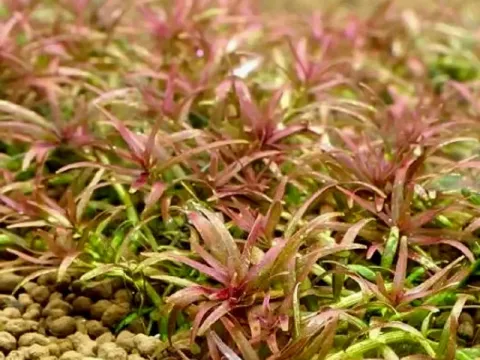
Ammannia pygmaea
Ammannia pygmaea
Ammannia pygmaea is a small herbaceous plant belonging to the Lythraceae family. Naturally, it inhabits the tropical regions of Asia, typically found in wet, marshy, or periodically flooded areas, which dictates its preference for consistently moist substrates and high humidity.
What the section contains
Ammannia pygmaea
Botanically, this species is distinguished by its small, lanceolate leaves arranged in opposite pairs along the stem. It displays high plasticity, adapting its morphology to submerged or terrestrial growth, although the coloration tends to be more vibrant under intensive light and optimal nutrient supply.
The cultivation of this plant requires a high-intensity lighting setup to maintain its compact growth habit and natural coloration. Temperatures should remain within a stable range of 22°C to 28°C; significant fluctuations can lead to stress, causing leaf abscission and stunted growth.
For best results, the substrate must be rich in organic matter and iron, which is essential for healthy development. In hydroponic or controlled environments, it is crucial to ensure that the water chemistry remains stable, particularly the pH levels, which should ideally be slightly acidic.
Standard agrotechnical practices for Ammannia pygmaea include regular water changes and controlled fertilization. Since it is a slow-growing species, careful monitoring of nutrient levels is vital to prevent toxic buildups that can damage the delicate root system of the plant.
The primary threat to Ammannia pygmaea is the rapid encroachment of filamentous algae, which occurs when nutrient levels in the water column become unbalanced. These algae compete for light and CO2, eventually suffocating the smaller, slow-growing stems of the plant.
Furthermore, improper soil aeration can lead to root rot, a common ailment that manifests as yellowing and subsequent decay of the lower leaves. Maintaining adequate water circulation and avoiding excess organic waste is necessary to prevent the proliferation of pathogenic bacteria and fungi.