
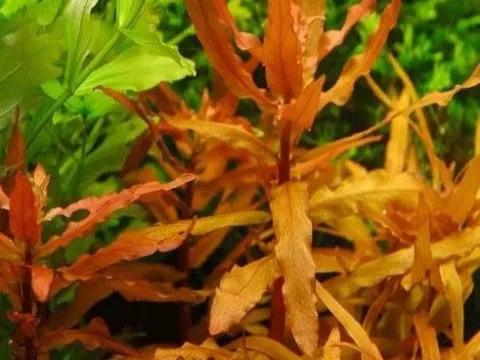
Ammannia senegalensis
Ammannia senegalensis
Ammannia senegalensis is an herbaceous plant belonging to the Lythraceae family, native to tropical regions of Africa. It naturally inhabits wetlands and riverbanks, thriving in warm, humid environments with nutrient-rich soils.
What the section contains
Ammannia senegalensis
The plant is highly valued for its striking, copper-red foliage, which adds a vibrant contrast to aquatic landscapes. It features an upright growth pattern with opposite leaves, making it a popular choice for high-tech aquatic setups.
Successful cultivation requires very high lighting intensity. Without sufficient light, the plant struggles to maintain its intense reddish color and will likely shed its lower leaves as the stem becomes increasingly elongated and thin.
Temperature management is crucial, with an optimal range between 22 and 28 degrees Celsius. The species prefers soft to medium-hard water and benefits significantly from supplemental carbon dioxide injection to promote robust and healthy growth.
Soil quality is paramount, requiring a rich, iron-heavy substrate. Regular fertilization is necessary, as the plant acts as a heavy feeder, extracting significant nutrients through both its foliage and its well-developed root system.
The most common threat to Ammannia senegalensis is an infestation of nuisance algae. Rapidly growing algae can smother the leaves, preventing photosynthesis and ultimately leading to the decay of the entire plant stem.
Iron deficiency frequently manifests as chlorosis, where the leaves become pale and stunted. This is a common physiological disorder that must be addressed immediately with iron-chelate additives to restore the plant's health.
Inconsistent nutrient levels often cause the lower leaves to drop, a sign of stress often seen when nitrate and phosphate ratios are out of balance. Stability in water parameters is essential to prevent such shedding.
Poor water circulation can lead to root rot, particularly in dense, compact substrates. Ensuring adequate flow around the base of the plant is vital to prevent anaerobic conditions that can harm the root system.
While generally resistant to insects in fully aquatic conditions, snails can occasionally damage the tender apical meristems. Proactive maintenance and monitoring are recommended to ensure the long-term survival of the crop.