
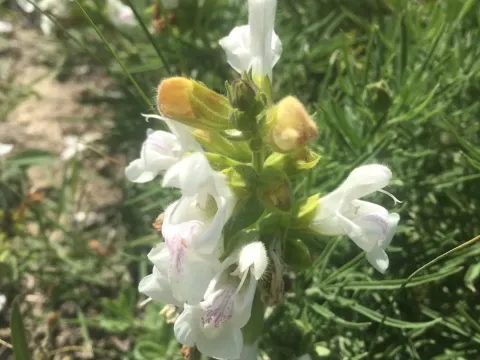
Scabiosa-leaved sage
Salvia scabiosifolia
Sowing of Scabiosa-leaved sage seeds is carried out in early spring as soon as the soil warms up to 6-8 degrees Celsius. Late autumn sowing is also permitted, allowing the seeds to undergo natural stratification in the soil, which facilitates more uniform germination in the spring.
What the section contains
Scabiosa-leaved sage
Seeds are sown in rows spaced 45-60 centimeters apart, providing optimal growing space for the leaf rosettes and flower stalks. The sowing depth in light soils is 1-2 centimeters, while in heavier loams it is recommended to reduce it to 1 centimeter to prevent delayed emergence.
The seeding rate is calculated based on the seed quality and sowing method, averaging 4-6 kilograms per hectare. Using high-quality seed material with high germination energy is key to obtaining a dense and healthy stand of the crop.
After sowing, the field must be rolled to ensure firm contact between the seeds and the soil, preventing desiccation in the top layer. It is crucial to monitor for soil crusting, which can become an impassable barrier for the weak sprouts of this essential oil-bearing crop.
Scabiosa-leaved sage is a perennial plant, allowing it to be cultivated on the same plot for 5-7 years. Re-sowing on the same field is recommended only after 3-4 years, adhering to crop rotation principles to prevent the accumulation of specific soil-borne pathogens.
The crop belongs to the Lamiaceae family and is characterized by high drought tolerance, making it suitable for regions with limited precipitation. The plant prefers open, well-lit areas, as shading leads to a sharp decrease in the concentration of essential oils in the biomass.
Successful vegetation requires moderately fertile, well-aerated soils with a neutral or slightly alkaline pH. Sage reacts negatively to waterlogging and acidic soils; therefore, sites with high groundwater tables are strictly unsuitable for commercial cultivation.
The optimal temperature for growth is 20-25 degrees Celsius, although the plant has high frost resistance and can survive winter temperatures below -20 degrees Celsius under snow cover. Sufficient moisture is essential during the spring for vigorous vegetative development.
The fertilizer program must include phosphorus and potassium supplements, which enhance the overall resistance of the plants to adverse weather conditions. Nitrogen fertilizers are applied with caution, primarily during the first half of the growing season, to avoid excessive nitrate accumulation in the raw material.
Field maintenance involves systematic inter-row cultivation to control weeds and improve soil aeration. Mechanized cultivation is performed several times per season, taking care not to damage the root system located in the upper soil horizon.
One of the most common problems is powdery mildew, which manifests as a white coating on the leaves. The disease develops actively under high humidity and temperature fluctuations, requiring the use of preventive fungicides early in the growing season.
Root rots may occur in areas with poor drainage, where excess moisture leads to the infection of the root collar by pathogenic fungi. To combat this, it is critical to adhere to irrigation schedules and provide quality soil management to prevent water stagnation.
Pests such as the sage moth and meadow moth can cause significant damage to the crop by attacking the leaves and reproductive organs. To control their populations, both biological control agents and insecticides are used, provided there is enough time before the harvest.
Nematodes pose a hidden threat, damaging roots and causing stunted growth. Using healthy seed material and following proper crop rotation are the only effective methods to prevent the spread of this pest in commercial plantations.
Aphids and other sucking insects can act as vectors for viral diseases, leading to leaf deformation and reduced productivity. Monitoring the status of the crops during critical growth phases allows for timely interventions to protect the plants.
Harvesting begins during the mass flowering stage, when the concentration of essential oils in the plant reaches its peak. Typically, this period falls in mid-summer, depending on the climatic zone and the specifics of the current growing season.
The mown green mass is promptly transported to processing or drying facilities to avoid self-heating and the loss of aromatic compounds. The time between mowing and drying must be kept to a minimum to preserve product quality.
For essential oil extraction, the steam distillation method is used, allowing the separation of volatile components from fresh or wilted raw material. Final product quality directly depends on the cleanliness of the harvested mass and the absence of impurities like weeds.
Drying for pharmaceutical or food applications is conducted in specialized dryers at temperatures not exceeding 40-45 degrees Celsius. Higher temperatures lead to the evaporation of valuable components and the degradation of the plant's organoleptic properties.
Post-harvest activities include irrigation and loosening of the soil, if necessary, to prepare the plants for winter. Properly conducted post-harvest measures contribute to better plant recovery for the following year and ensure yield stability.