
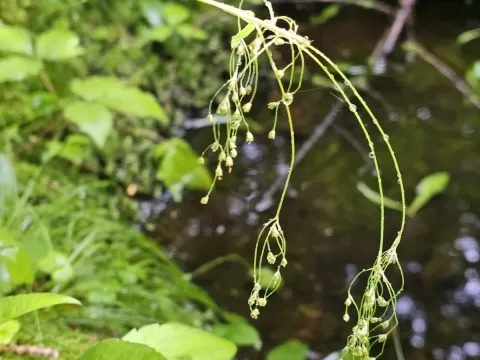
Small-flowered wood-rush
Luzula parviflora
Small-flowered wood-rush (Luzula parviflora) is a perennial herbaceous plant belonging to the Juncaceae family. It is distinct for its grass-like appearance, though it belongs to the rush family, commonly found in boreal and arctic environments.
What the section contains
Small-flowered wood-rush
The plant has a wide distribution range across the Northern Hemisphere, spanning from arctic tundra regions to alpine zones. It is a dominant species in many northern grassland ecosystems and open woodlands.
Environmental requirements for this species are relatively specific, as it thrives in cool, moist, and acidic soil conditions. It is highly tolerant of low nutrient levels, allowing it to colonize areas where other vegetation struggles.
Climatic resilience is a key characteristic of the small-flowered wood-rush. It is evolutionarily adapted to short growing seasons, cold soil temperatures, and high levels of moisture, often found in proximity to mountain streams or bogs.
Botanically, it forms loose tufts or stands connected by short rhizomes. This growth habit enables the plant to spread vegetatively, which is an effective strategy for surviving in nutrient-poor and harsh environmental conditions.
Economically, the small-flowered wood-rush serves as an essential source of forage for grazing animals, particularly reindeer in arctic pastoral systems. It remains a reliable feed source due to its growth cycle.
While not typically farmed as a traditional industrial crop, its ecological role is significant. It supports biodiversity and provides soil stabilization in fragile arctic landscapes, preventing erosion in exposed areas.
In research contexts, the plant is studied for its ability to thrive in depleted soils, suggesting potential applications in soil remediation or reclamation projects in cold, northern regions with poor soil quality.
For gardening and landscaping, it is valued for its ability to handle shade and moisture, making it an excellent candidate for native plant gardens that require low maintenance and minimal chemical inputs.
- Cold resistance
- Adaptation to acidic soils
- Low maintenance requirements