
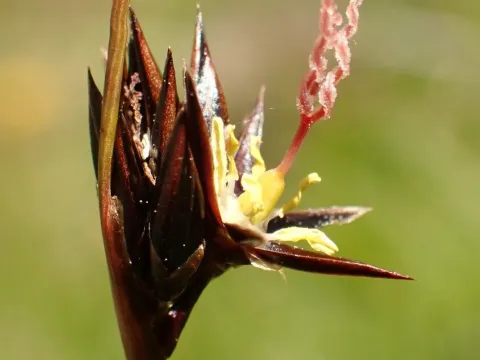
Juncus jacquinii
Juncus jacquinii
Juncus jacquinii, commonly known as Jacquin's rush, is a perennial herbaceous plant belonging to the Juncaceae family. It is a specialized species native to high-altitude mountain ranges in Europe, specifically adapted to subalpine and alpine climate zones where it thrives in harsh conditions.
What the section contains
Juncus jacquinii
Botanically, the plant is recognized by its dense tufted growth habit and stiff, erect stems. The inflorescence consists of small clusters of flowers, which are typically protected by a long, leaf-like bract that extends beyond the flower head, a signature trait of this particular rush species.
Regarding soil and site requirements, this species favors moist, nutrient-poor, and acidic substrates. It is frequently found in waterlogged alpine meadows, along the edges of mountain springs, and on rocky slopes where moisture accumulates throughout the growing season.
The climate requirements for Juncus jacquinii include tolerance to extreme temperature fluctuations and short growing seasons. The plant is well-evolved to withstand high levels of solar radiation and persistent winds typically found at high altitudes, ensuring its survival in demanding ecosystems.
From a utilization perspective, while it is not a traditional agricultural crop, its ecological role is significant. It is increasingly utilized in ecological restoration projects for soil stabilization on steep slopes and as an ornamental choice for specialized rock gardens and alpine-themed landscapes.