
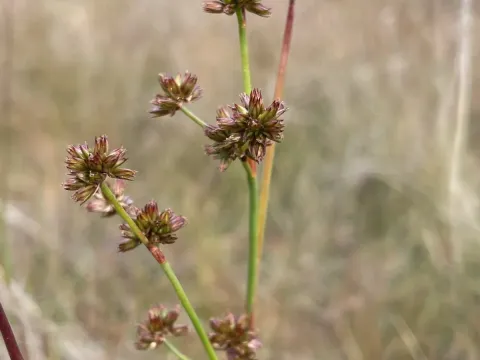
Juncus holoschoenus
Juncus holoschoenus
Juncus holoschoenus, commonly known as the roundhead rush, is a perennial herbaceous plant belonging to the Juncaceae family. It is naturally adapted to moist, riparian environments, including marshes, riverbanks, and seasonally saturated grasslands.
What the section contains
Juncus holoschoenus
The plant exhibits significant ecological resilience, particularly in wetlands where water levels fluctuate. It thrives in soils that remain consistently moist, as its root system is evolutionarily specialized to function in low-oxygen, saturated soil environments.
Soil requirements focus on neutral to slightly acidic substrates that are rich in organic matter. While it is tolerant of various soil textures, it performs best in silty or clay-heavy soils that retain moisture efficiently throughout the active growth season.
Climate preferences for this species are temperate and subtropical. It requires ample sunlight for optimal physiological activity and biomass accumulation. Cold tolerance is moderate, and it generally recovers well after winter dormancy in its native ranges.
Agricultural management requires careful moisture control to prevent soil desiccation. In cultivated setups, ensuring consistent water levels is paramount for crop health. Avoid excessive fertilization, which can lead to rapid weed competition rather than increased rush growth.
The agricultural and economic utility of Juncus holoschoenus is primarily oriented toward ecological restoration and environmental engineering. It serves as an excellent stabilizer for wetland soil, preventing shoreline erosion in managed ponds.
In certain regions, it is harvested for its fibrous stalks, which are utilized in artisanal weaving and the production of eco-friendly packing materials. These fibers are relatively tough, providing durability to finished products.
Yields of biomass are highly variable based on water availability and soil nutrient profiles. In optimal, managed wetlands, the species can produce a significant amount of vegetation suitable for harvest, provided that the soil hydrology remains stable.
As a forage crop, it is generally considered suboptimal due to high silica content, which reduces digestibility for livestock. It is not typically grown for pasture, although grazing animals may consume young shoots if alternative food sources are scarce.
Commercial sustainability depends on long-term water management. Regular harvesting of the biomass can stimulate new growth, but managers must avoid over-harvesting, which can degrade the root system and diminish future yields.
Fungal pathogens are the most common threat to Juncus holoschoenus, particularly under conditions of poor air circulation and excessive humidity. Stem rot can compromise the structural integrity of the plant, leading to reduced yield quality.
Insects and pests are generally minimal in native habitats; however, in artificial monoculture settings, stem-boring larvae may occasionally cause localized damage. Constant monitoring is recommended to prevent significant pest pressure.
Weed competition during the establishment phase is critical. Rapidly growing opportunistic plants can quickly outcompete young rushes for space and light, requiring manual or selective mechanical weeding to secure the success of the stand.
Physiological stress arises mainly from sudden shifts in water tables. Prolonged drought leads to senescence and allows for the encroachment of more resilient, drought-tolerant species that can easily displace the rush colony.
Preventive strategies include maintaining appropriate spacing between clusters and ensuring clear access for air movement across the site. Sustainable water management practices are the best defense against environmental and biological threats to the species.