
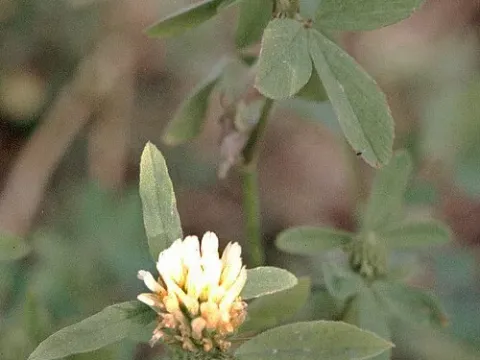
Rueppell's clover
Trifolium rueppellianum
Rueppell's clover, scientifically known as Trifolium rueppellianum, is a robust legume species originating from the highland regions of Eastern Africa.
What the section contains
Rueppell's clover
For successful establishment, the seeds should be sown during the period of stable soil temperatures, ideally when the weather remains consistently mild.
Given the small size of the seeds, they require shallow sowing at a depth of 1 to 2 centimeters to ensure adequate moisture intake for germination.
Field preparation should include light harrowing to create a firm, fine seedbed, facilitating optimal seed-to-soil contact for uniform emergence.
In regions with distinct rainy seasons, planting is typically scheduled to coincide with the onset of precipitation to maximize initial growth rates.
The species thrives in well-drained loamy soils and exhibits a remarkable tolerance for the cool conditions typical of mountainous climates.
It prefers areas with good sun exposure, although it displays a high degree of phenotypic plasticity depending on local environmental stressors.
Soil pH should ideally be neutral or slightly acidic; extreme soil conditions may inhibit the formation of nitrogen-fixing root nodules.
Good drainage is essential, as the species is sensitive to waterlogging, which can trigger fungal pathogens and stunt overall development.
Inoculation with compatible Rhizobium strains may be necessary in areas where the specific legume-bacteria relationship has not been naturally established.
The plant provides high-quality forage, characterized by a favorable balance of proteins and minerals essential for livestock health.
Under managed grazing or periodic harvesting, the clover demonstrates strong regrowth capabilities, allowing for multiple cuts within a single season.
Yield stability is heavily influenced by the availability of water, making it a productive candidate for areas with moderate to high annual precipitation.
The nutritional profile remains high even in mature stands, making it a sought-after component for mixed pasture systems in tropical highland agriculture.
Biomass production is generally optimized when intercropped with compatible grasses, which provide structural support and prevent soil erosion.
Fungal diseases, particularly leaf spots and root rots, are the primary biological threats especially under conditions of high humidity and poor ventilation.
Insect pests such as clover weevils can cause significant damage to the foliage and developing seeds if populations are not monitored.
Early detection of pathogen hotspots is critical, necessitating periodic inspections during the peak growth phases of the crop cycle.
Cultural control measures, including appropriate crop rotation and removal of crop residues, are vital to reducing the pressure of pests and diseases.
Proper field hygiene helps to maintain the long-term health of the crop and prevents the build-up of soil-borne pathogens over multiple years.
For high-quality silage or hay production, harvesting is recommended during the early flowering stage to preserve the highest protein content.
Grazing intervals should be strictly managed to prevent overgrazing, which can degrade the plant base and reduce future production potential.
Seed harvesting should be performed when the pods turn dark brown, indicating full maturity, to minimize harvest losses from pod shattering.
Mechanical harvesting equipment should be set to a height that allows for quick canopy recovery, ensuring the plant remains vigorous for subsequent seasons.
Post-harvest storage requires moisture control to maintain seed viability and prevent the development of mycotoxins in stored hay material.