
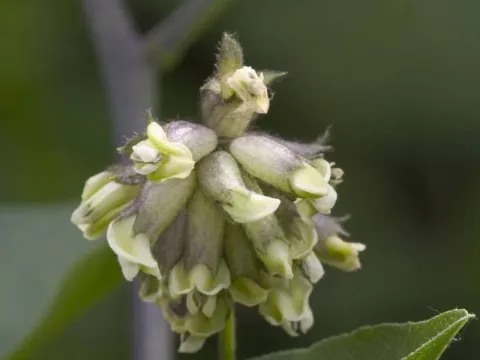
Rupertia
Rupertia
Rupertia is a genus of perennial herbaceous plants belonging to the Fabaceae family. This genus, which includes species such as Rupertia physodes, was formerly classified under the Psoralea genus. Today, it is recognized as a distinct taxonomic group native to the western regions of North America.
What the section contains

Rupertia
The plant originates from the diverse landscapes of the United States and Canada, frequently inhabiting open forests, mountain slopes, and grassland prairies. Its role in these ecosystems is significant, as it contributes to the local flora diversity and provides essential habitat and nutrients for various insect and animal species.
Botanically, Rupertia is characterized by a sturdy taproot system, which is an adaptation to fluctuating moisture levels in its natural habitat. The foliage typically consists of trifoliate leaves, and the stems are often glandular. The flowers emerge in racemes, displaying a classic pea-flower morphology, typically in creamy or yellowish-white hues.
From an agricultural and ecological standpoint, Rupertia is notable for its nitrogen-fixing capabilities. By forming symbiotic relationships with specialized soil bacteria, it contributes to soil fertility, making it a plant of interest for land restoration and sustainable forage production projects.
While not currently a widely commercialized agricultural commodity, Rupertia is researched for its potential as a forage crop. Its ability to thrive in poor soils and withstand dry conditions makes it a candidate for integration into pastoral systems, particularly in regions where intensive agriculture is less feasible.
Rupertia thrives in well-drained, sandy, or loamy soil types. It is highly sensitive to waterlogged environments, as excess moisture can negatively impact the root system and inhibit the development of nitrogen-fixing nodules.
The plant requires full sun to partial shade for optimal photosynthesis and growth. It is relatively adaptable to various environmental conditions within the temperate zone but performs best when given consistent exposure to light.
Drought tolerance is one of the key characteristics of the genus. The deep-reaching root system allows Rupertia to access sub-surface water, making it a resilient plant during dry spells that would typically stress shallower-rooted crops.
Regarding soil fertility, Rupertia is efficient at utilizing available nutrients and does not require high levels of synthetic nitrogen fertilization, as it maintains its own nitrogen balance through biological fixation.
Site selection should prioritize areas with good air circulation and soil aeration to minimize the risk of fungal diseases, which can arise if the microclimate remains excessively humid for long durations.