
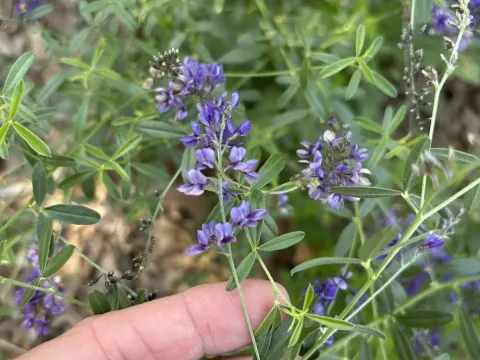
Psoralea tenuiflora
Psoralea tenuiflora
Psoralea tenuiflora is a hardy perennial legume known for its deep root system and significant resilience in diverse environments.
What the section contains
Psoralea tenuiflora
Sowing should take place in early spring after the frost danger has passed and soil temperature reaches consistent levels for germination.
Due to the hard-seeded nature of this species, scarification is highly recommended to improve the success rate of crop establishment.
Seeds are typically sown at a depth of 2 to 3 centimeters, ensuring adequate seed-to-soil contact for optimal moisture absorption.
Row spacing should be managed to allow for efficient weed control while maintaining optimal density for biomass production.
This crop thrives in well-drained, sandy or gravelly soils where it can develop its characteristic taproot without restriction.
It is remarkably drought-tolerant, surviving long periods of water scarcity that would be detrimental to other conventional agricultural legumes.
Full sun exposure is vital for the development of Psoralea tenuiflora, as it requires high light intensity to maximize its photosynthetic capacity.
The plant demonstrates excellent nitrogen-fixing properties, contributing to soil health and nutrient cycling in depleted agricultural lands.
It is well-adapted to temperate climates and can withstand significant seasonal temperature fluctuations without losing productivity.
Yield capacity of Psoralea tenuiflora is largely dependent on soil quality, precipitation patterns, and the age of the established stand.
As a perennial crop, biomass yield typically increases over the first few years as the root system matures and occupies deeper soil layers.
Harvesting for forage or other uses must be timed carefully to allow the plant to recover and store enough energy for winter dormancy.
Sustainable harvesting practices ensure the longevity of the stand, allowing for multiple years of consistent production from a single sowing.
Average biomass production is competitive in areas where high-input crops struggle due to water limitations or nutrient deficiencies.
Potential threats include root rot pathogens that may emerge if the soil remains waterlogged for extended periods during the growing season.
Generalist herbivorous insects may occasionally feed on the foliage, although the plant's chemical composition often provides some degree of defense.
Effective management includes regular field monitoring and maintaining adequate distance between susceptible legume crops to reduce pathogen spread.
Avoidance of excessive irrigation is the most critical factor in preventing the establishment of fungal diseases in Psoralea plantations.
Integrated pest management strategies focusing on biological control are preferred to maintain the ecological balance of the cultivated area.