
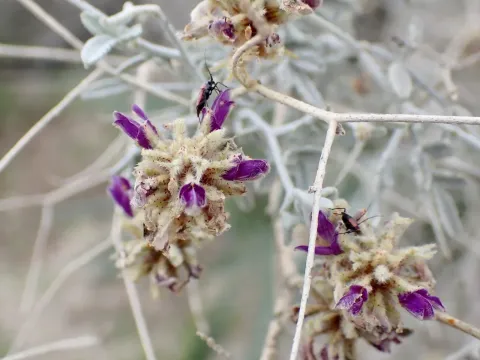
Psorothamnus
Psorothamnus
Psorothamnus is a genus of perennial shrubs belonging to the legume family (Fabaceae). Native to the arid regions of North America, these plants have evolved to survive in harsh desert environments by developing specialized mechanisms for water retention and nutrient uptake.
What the section contains

Psorothamnus
Botanically, Psorothamnus species are characterized by their deep root systems and glandular foliage, which help reduce water loss through transpiration. These shrubs are perfectly adapted to environments with high solar radiation and extremely low annual precipitation, making them key components of desert ecosystems.
For agricultural or reclamation purposes, Psorothamnus requires well-drained, sandy or gravelly soils. They struggle in heavy or clay-rich soils that retain moisture for too long, as they are highly susceptible to root rot in conditions of high humidity or poor drainage.
The climate requirements for this culture are centered on heat tolerance and direct sunlight exposure. Psorothamnus thrives in high-temperature environments and requires minimal maintenance once established, provided it is planted in an open area with full solar access.
The primary agricultural use for Psorothamnus is in soil erosion control and land restoration projects. As a nitrogen-fixing plant, it improves soil quality in nutrient-poor desert regions, acting as a pioneer species that facilitates the stabilization and revitalization of degraded landscapes.
The main threats to Psorothamnus health are water-related stresses, primarily caused by waterlogging in the root zone. When soil drainage is insufficient, fungi and oomycetes can quickly colonize the root system, leading to rapid plant decay and structural failure.
While pests are generally not a significant issue due to the plant's chemical defenses, certain coleopterans may feed on flowers or fruits, potentially impacting seed production. Managing these threats involves careful site selection and ensuring that the irrigation regime strictly avoids water accumulation around the stem base.