
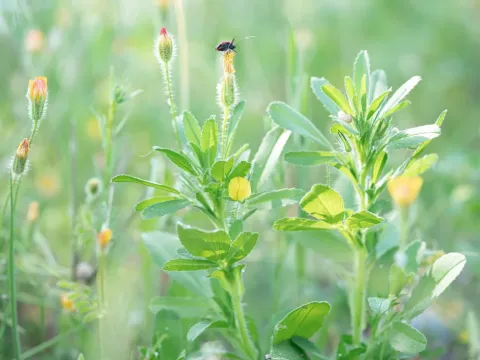
Sticky restharrow
Ononis viscosa
Sticky restharrow (Ononis viscosa) is an annual herbaceous plant belonging to the Fabaceae family. Native to the Mediterranean region, it has adapted to semi-arid environments and rocky or sandy soil types.
What the section contains
Sticky restharrow
The crop requires full sun exposure and warm climatic conditions for optimal development. It thrives in well-drained soils, as waterlogging is detrimental to its root system and can lead to rapid physiological decline.
Its botanical structure includes a deep taproot that allows the plant to reach moisture stored in lower soil layers during summer heat. The stems and leaves are covered with glandular hairs, which give the plant its characteristic sticky texture and unique aroma.
Agrotechnical management should focus on maintaining a weed-free environment during the early growth stages, as the crop lacks initial competitive strength. Providing sufficient spacing between rows is essential for proper light distribution.
Fertilization regimes for this crop are generally low-input. Due to its nitrogen-fixing ability, the plant usually performs well without excessive nitrogen supplementation, though phosphorus may be added to encourage root development.
Like many members of the legume family, Ononis viscosa is susceptible to various fungal pathogens under high humidity conditions. Root rot and damping-off are common risks in heavy or poorly drained soils.
Pest management focuses primarily on aphids and various types of weevils that feed on the foliage and reproductive structures of the plant. Monitoring for early signs of infestation is crucial for high-yield results.
Crop rotation remains the most effective strategy for preventing the buildup of soil-borne pathogens and insect pests. Avoiding sequential planting of legumes in the same field helps maintain soil health.
Cultural control measures include proper field sanitation and the removal of plant residues after harvest to interrupt the life cycle of overwintering pests. This practice significantly reduces the need for chemical intervention.
In cases of severe infestation, targeted application of biopesticides or specialized insecticides may be employed. Careful timing of treatments ensures that the natural balance of beneficial predatory insects is preserved.