
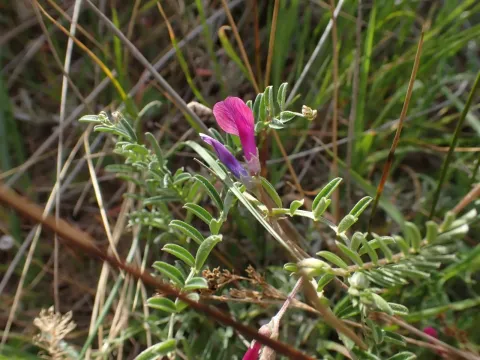
Spurred vetch
Vicia monantha
Spurred vetch is cultivated as both a winter and spring crop depending on regional climatic zones. In warmer Mediterranean environments, sowing is performed in autumn, allowing the plant to establish a deep root system before the onset of extreme winter temperatures, ensuring early biomass production in the following spring.
What the section contains
Spurred vetch
For spring sowing, operations are scheduled as early as soil conditions allow, typically when the soil temperature reaches 5 to 8 degrees Celsius. This early start is crucial for the plant to leverage residual winter moisture, which supports rapid canopy development before the arrival of summer heat.
Seeding rates are adjusted based on the specific end-use; for green manure or heavy forage yields, higher densities are preferred to suppress weed competition. For seed production, lower densities are used to ensure adequate light penetration and proper pod development, typically at a depth of 3 to 5 cm.
The crop shows significant plasticity regarding sowing windows, though delayed sowing often results in reduced vegetative growth due to heat stress during the reproductive phase. Consistent plant spacing is essential to ensure a uniform field structure, facilitating easier management during the growth cycle.
Intercropping spurred vetch with winter cereals, such as rye or barley, is a common practice that provides structural support to the vetch vines. This combination not only prevents lodging but also increases the quality of the resulting haylage while simplifying the harvesting process.
Spurred vetch belongs to the Fabaceae family and is highly valued for its exceptional drought tolerance and ability to thrive on marginal soils. It is widely cultivated across the Mediterranean basin and parts of the Middle East, regions characterized by variable rainfall and hot, dry summers.
The crop is not overly demanding in terms of soil fertility, preferring neutral to slightly alkaline loams with excellent drainage. It is particularly sensitive to waterlogging, which significantly increases the risk of root rot and can lead to rapid stand depletion in heavy or compacted soils.
Biological nitrogen fixation is a cornerstone of its productivity, relying on symbiosis with specific Rhizobium bacteria. If planting on fields where the crop has not been previously grown, inoculation of seeds is highly recommended to ensure effective nodulation and optimal nitrogen availability.
Spurred vetch exhibits remarkable heat tolerance during the flowering and pod-filling stages, a period when many other vetch species suffer from physiological decline. This makes it a strategic crop for regions experiencing climate volatility and increasing summer temperatures.
The plant develops a robust taproot system that explores deep soil layers, enabling the crop to access subsoil moisture. This characteristic not only benefits the vetch itself but also contributes to soil aeration and the improvement of the physical structure of the topsoil for subsequent rotational crops.
The green biomass yield of spurred vetch is highly responsive to moisture availability and overall soil management practices. Under favorable conditions, it provides yields comparable to traditional forage legumes, offering a valuable source of protein for livestock grazing or ensiling.
Seed yields typically range from 1.5 to 2.5 tonnes per hectare, depending on local environmental factors and the effectiveness of weed management. Uniformity in pod ripening is a key concern, as the pods can become brittle and prone to shattering if harvesting is delayed during hot, dry weather.
To maximize forage quality, the crop should be harvested at the onset of pod formation, when the plant's nutritional profile, including crude protein content, is at its peak. Delaying harvest results in increased fiber content and stem lignification, which reduces digestibility for livestock.
While spurred vetch has limited regrowth potential compared to certain varieties of common vetch, its initial biomass accumulation is quite efficient. Most management systems focus on a single high-quality harvest, timed to coincide with the plant's peak vegetative stage.
The nitrogen-fixing capacity of the crop creates a positive residual effect in the soil, which benefits the subsequent cereal crops in the rotation. This contribution to soil fertility provides an indirect economic benefit that adds value to the vetch production cycle.
Powdery mildew is a primary disease concern for spurred vetch, particularly in environments with high humidity and stagnant air. Maintaining appropriate plant densities and ensuring good field ventilation are effective cultural practices for preventing the spread of fungal pathogens.
Insects like the pea leaf weevil can cause significant damage to young seedlings by feeding on the leaves and damaging the root nodules. Additionally, aphid infestations during the growing season can serve as vectors for various viral diseases, potentially compromising the overall plant health.
Anthracnose and various forms of rust may occur in seasons with prolonged rainfall, impacting the quality of the forage. Because spurred vetch is primarily used as animal feed, chemical control is often restricted to minimize residue risks, placing greater emphasis on integrated pest management.
Weed control during the early stages of development is critical, as spurred vetch grows relatively slowly during the first few weeks after emergence. Timely mechanical weeding or the use of selective herbicides is necessary to ensure the crop establishes a dominant position in the field.
Monitoring the field during the budding stage allows for the early detection of pest outbreaks. By employing diversified crop rotations, farmers can disrupt the life cycles of common pests and diseases, thereby reducing the need for intensive chemical interventions.
Harvesting for seed should be conducted when the lower pods have turned brown, while the upper ones are still slightly green, to prevent shattering losses. Careful timing is essential to ensure maximum grain recovery and to maintain seed viability for future planting seasons.
Direct combining is the preferred method of harvest when the fields are free from heavy weed infestation. In contrast, if the crop is heavily infested with weeds, a swathing method, where the crop is cut and left to dry in windrows, is more effective before final threshing.
For forage production, the use of mower-conditioners is highly recommended to accelerate stem drying and ensure uniform moisture loss. This practice is vital for preserving the nutritional value and ensuring that the forage meets quality standards for storage or immediate feeding.
Post-harvest processing involves cleaning the seeds of impurities and drying them to a moisture content of 14% or less. Proper storage in cool, dry conditions is essential to protect the seed lots from fungal growth and to maintain high germination rates for the following season.
Modern harvesting equipment, specifically designed for small-seeded legumes, helps reduce seed loss during the cutting process. Since spurred vetch has a tendency to lodge, utilizing floating cutter bars or lifter attachments on headers can significantly increase total yield recovery.