
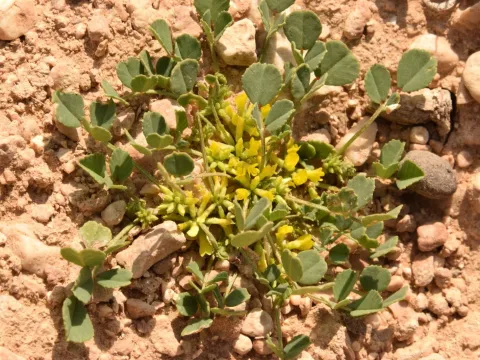
Star fenugreek
Trigonella stellata
Star fenugreek belongs to the Fabaceae family and is an annual herbaceous plant. The sowing period for this crop typically begins in early spring, once soil temperatures reach 8-10 degrees Celsius.
What the section contains
Star fenugreek
Consistent soil moisture is essential for successful germination. In arid regions, sowing is conducted in late autumn or very early spring to ensure plants benefit from seasonal moisture before heat sets in.
Seeds are typically sown at a depth of 2–3 centimeters, depending on the soil texture. Optimal plant density is achieved with row spacing of 15–30 centimeters.
Fenugreek seeds exhibit strong germination vigor when the seedbed is well-prepared. It is crucial to ensure good seed-to-soil contact to achieve uniform emergence across the field.
The crop demonstrates rapid early development, allowing it to compete effectively with weeds during the initial stages of the growing cycle.
The plant prefers well-drained, fertile loamy or sandy soils with a neutral to slightly alkaline pH. It demonstrates notable tolerance to soil salinity, making it suitable for diverse environments.
Star fenugreek is a heliophilic (light-loving) species that requires open areas without shading. In low-light conditions, biomass accumulation and general productivity decline significantly.
Water requirements are moderate; however, the crop does not tolerate prolonged waterlogging or soil compaction. It shows good adaptability to short periods of drought.
The optimal temperature range for active vegetation is between 18 and 25 degrees Celsius. While it can withstand light spring frosts, extreme temperature fluctuations may hinder metabolic processes.
In crop rotation, star fenugreek performs best when following cereals or row crops that do not share common soil-borne pathogens.
The yield of green biomass depends on the level of agricultural management and water availability. Under favorable conditions, farmers can expect 15 to 25 quintals of biomass per hectare.
Seed harvesting requires careful timing, particularly with desiccation, due to uneven ripening of the pods. Average seed yields reach approximately 5–8 quintals per hectare.
The plant is biologically characterized by an extended flowering period, leading to multi-stage pod formation. Regulated irrigation helps stimulate more uniform ripening.
To boost yields, phosphorus and potassium fertilizers are recommended to strengthen root systems. Nitrogen fertilizers should be applied sparingly, primarily on nutrient-poor soils.
Product quality is defined by the purity of the harvested material, necessitating precise calibration of threshing equipment to prevent damage during harvest.
Key pests include clover root curculio, which can damage root systems and foliage. Timely application of approved insecticides is effective in controlling pest populations.
Regarding plant health, powdery mildew and various root rots are the most significant threats. High humidity and high crop density often promote the development of these pathogens.
To prevent disease outbreaks, strict adherence to crop rotation is advised. Returning the crop to the same field sooner than every 3–4 years is not recommended.
Weed management is critical during early development; both mechanical weeding and selective herbicides are utilized to keep fields clean.
Monitoring the crop during the budding phase allows for early detection of potential disease hot-spots, enabling intervention before significant yield loss occurs.
Seed harvesting is conducted when pods reach full maturity and change color. Delaying the harvest can result in pod shattering and substantial field losses.
For high-quality forage or hay, mowing should take place during the mass flowering stage, when protein content and nutritional value are at their peak.
Harvesting techniques include direct combining or two-stage harvesting (swathing followed by pick-up), depending on local weather patterns and weed pressure.
Once harvested, the material must be promptly cleaned and dried to reach a safe moisture level for long-term storage in ventilated facilities.
Utilizing modern agricultural machinery minimizes mechanical damage to seeds, preserving their viability and commercial marketability.