
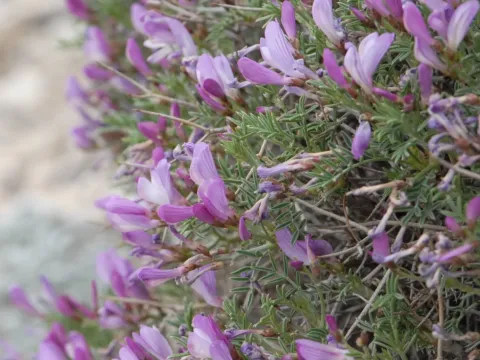
Horned sainfoin
Onobrychis cornuta
Horned sainfoin Onobrychis cornuta is a perennial subshrub belonging to the Fabaceae family. Sowing is typically performed in early spring as soon as the soil is dry enough to handle, ensuring sufficient moisture for seed germination.
What the section contains
Horned sainfoin
Effective seedbed preparation is crucial; the field must be cleared of weeds to ensure the young plants have minimal competition during their establishment phase.
The seeds should be planted at a depth of 2 to 4 centimeters. Precise depth control is essential to promote uniform emergence across the entire field.
Seeding rates are adjusted based on the intended density of the stand, as the plant exhibits significant branching and biomass production throughout the growing season.
Post-seeding compaction is recommended to enhance the seed-to-soil contact, which is vital for the survival of the crop in regions where moisture is a limiting factor.
This species is highly valued for its extreme drought tolerance. It thrives in arid and semi-arid conditions, preferring well-drained, carbonate-rich soils that are unfavorable for other forage grasses.
The plant has a deep taproot system, which allows it to access water deep within the soil profile, ensuring growth even during prolonged dry spells.
Horned sainfoin requires full sun exposure and performs poorly in shaded areas or low-lying zones where air circulation is restricted and humidity remains too high.
The plant is frost-hardy and well-adapted to continental climates, making it an excellent choice for improving pastures in highland regions where winters can be severe.
It prefers alkaline to neutral soils and will suffer in acidic or waterlogged environments, which often lead to plant decline and the encroachment of undesirable weed species.
The biomass yield of horned sainfoin varies according to environmental conditions. While it may not provide the massive yields of irrigated crops, it offers consistent and high-quality production in harsh environments.
The forage is highly palatable and nutritionally dense, containing high levels of crude protein. It is widely recognized for its safety as a feed, as it does not cause bloat in ruminant livestock.
In addition to its fodder value, horned sainfoin is a significant nectar source, making it an excellent plant for supporting bee populations and enhancing local biodiversity.
When used as a pasture, the plant shows strong resilience to moderate grazing pressure and displays rapid regrowth, which extends the grazing season for sheep and goats.
Yield management should focus on maintaining a healthy leaf-to-stem ratio, as the foliage is where most of the essential nutrients for livestock are stored.
The most common issues for this crop are root rot diseases, which typically occur when the soil drainage is inadequate or during periods of excessive rainfall.
Foliar diseases like powdery mildew may appear if the canopy density is too high or if air humidity levels remain elevated for extended periods during the summer.
Various weevil species can be harmful, as they target both the foliage and the reproductive parts of the plant, potentially leading to significant reductions in seed yields.
Integrated pest management strategies, including crop rotation and monitoring, are essential to minimize the need for chemical intervention in the fields.
Using disease-free, high-quality seeds is the first line of defense in establishing a healthy and persistent stand of horned sainfoin in agricultural fields.
For hay production, the crop should be harvested during the full bloom stage. At this point, the plant provides the best balance of biomass volume and nutritional content.
When harvesting for seeds, farmers use a two-step process, cutting the plants when the lower pods turn brown to minimize shattering losses in the field.
Proper timing is critical because, after the flowering stage, the stems become woody, which significantly lowers the forage quality and digestibility for livestock.
After harvesting, it is important to manage the regrowth correctly. Ensuring that the plants enter the winter with sufficient stored carbohydrates is key to their long-term survival.
All harvested seed must be cleaned and dried to a safe moisture content to prevent spoilage and maintain high viability for future planting seasons.