
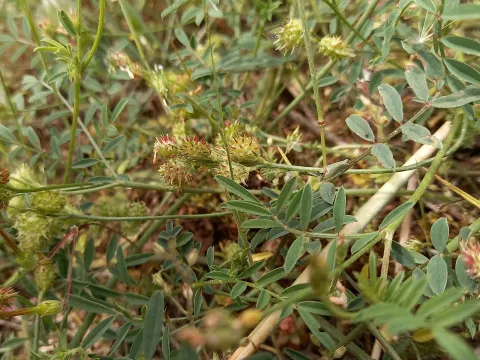
Cock's head sainfoin
Onobrychis caput-galli
Sowing of Cock's head sainfoin is best performed in early spring as soon as the soil reaches physical maturity. Early planting allows the crop to utilize winter moisture reserves for vigorous establishment of the taproot system.
What the section contains
Cock's head sainfoin
A drilling method is typically used for fodder production, while seed multiplication blocks may utilize wider row spacings to improve light penetration. Uniform seed placement is critical for consistent stand density across the field.
The seeding rate ranges from 60 to 100 kg per hectare, depending on local climate conditions and soil fertility levels. Seeds should be placed at a depth of 2 to 4 cm to ensure optimal emergence in various soil textures.
A firm, well-prepared seedbed is essential to promote fast and even germination. Rolling the field immediately after sowing is a recommended practice to ensure excellent seed-to-soil contact, especially in dry conditions.
Poorly compacted seedbeds often lead to delayed emergence and increased risk of crop failure. Careful management during the initial sowing phase significantly contributes to the long-term success of the stand.
Cock's head sainfoin (Onobrychis caput-galli) is a member of the Fabaceae family, highly valued for its drought resistance. It is well-adapted to semi-arid regions where water availability is a limiting factor for traditional forage crops.
The crop thrives in well-drained soils, specifically preferring loamy or calcareous soils with a neutral or alkaline pH. It does not perform well in acidic, poorly aerated, or waterlogged environments due to root sensitivity.
Sunlight is critical for the development of this species, so it should not be grown in shaded areas or competing with tall, fast-growing weeds. The plant requires moderate temperatures to achieve optimal vegetative growth.
Native to the Mediterranean region, this species has evolved to tolerate intense summer heat. Its ability to fix atmospheric nitrogen in symbiosis with rhizobia bacteria reduces the need for synthetic nitrogen fertilizers.
This crop is a hardy perennial in many climates, provided that soil moisture is not excessive during the dormant season. It is highly resistant to cold, making it a reliable choice for various agricultural landscapes.
The forage yield of Cock's head sainfoin is characterized by high nutritional quality, containing significant levels of protein and essential minerals. Livestock readily consume it in both green and hay forms.
The crop is highly valued for its persistence and ability to recover after harvesting. Depending on the local precipitation, it can provide multiple cuts per season, maintaining high fodder productivity throughout the year.
Sainfoin is also a vital plant for bees, serving as an excellent nectar source during its flowering phase. Integrating apiculture with sainfoin production offers economic benefits for many farming enterprises.
Soil health benefits are a major advantage, as the deep root system improves soil structure and promotes deeper nutrient cycling. These improvements often translate into higher yields for subsequent crops in the rotation.
Compared to other legumes, this species maintains its palatability longer throughout the growth stage. This flexibility in harvesting time allows farmers to manage their operations more efficiently during peak busy seasons.
Fungal diseases such as powdery mildew and Fusarium wilt are the primary risks, especially when field conditions are humid or the canopy is too dense. Proper ventilation and crop rotation are essential preventive measures.
Root rot is another common issue, usually resulting from inadequate drainage or soil compaction. Maintaining healthy soil structure and avoiding waterlogging is key to mitigating this risk.
Insects like the clover root weevil can damage young seedlings. Vigilant monitoring during the early developmental stages is necessary to apply timely control measures if pest populations exceed thresholds.
The sainfoin seed chalcid can severely affect seed production if left unmanaged. Regular monitoring during the pod formation period is recommended to determine the timing for necessary protective interventions.
Weed competition is a significant challenge during the establishment phase due to the plant's relatively slow initial growth. Managing fields for weed reduction before sowing is highly recommended for success.
The optimal time to harvest for hay is during the full bloom stage, as the nutritional content peaks at this time. Harvesting at this point ensures the highest digestibility and protein content for livestock.
When cutting for hay, care should be taken to avoid excessive mechanical handling to prevent leaf loss. Leaves are the most nutrient-dense part of the plant, and preserving them is essential for high-quality feed.
For seed production, harvesting should begin when the pods show a uniform brown color. Premature or late harvesting can lead to significant yield losses due to pod shattering or seed damage during processing.
Combining requires careful machine calibration to ensure seeds are cleaned effectively while minimizing physical damage. Harvesting during cooler morning or evening hours can help reduce seed shattering losses.
Post-harvest processing involves drying the seeds to a safe moisture level, typically below 13 percent, to prevent deterioration. Proper storage in cool, dry conditions is crucial to maintain seed viability until the next sowing cycle.