
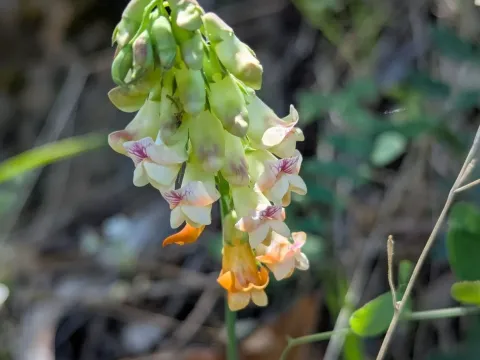
Sulfur-yellow pea
Lathyrus sulphureus
The sowing of Lathyrus sulphureus should be carried out in early spring as soon as the soil reaches a workable condition. Early planting ensures that seeds have access to sufficient moisture, which is essential for uniform germination and seedling establishment.
What the section contains
Sulfur-yellow pea
Proper field preparation involves deep plowing and leveling of the soil surface to create an optimal seedbed. Seeds should be sown at a depth of 3–5 cm, depending on the soil texture, to balance moisture retention and energy emergence.
High-quality seeds, preferably scarified to break dormancy, should be used for planting. This practice significantly increases the field germination rate and results in a more vigorous initial stand of plants.
The crop can be grown in pure stands or mixed with perennial grasses to improve forage quality. When sowing for seed production, lower seeding rates are recommended to ensure proper spacing and aeration.
Post-sowing rolling is a crucial step that improves the contact between the seed and the soil particles. This action helps to retain soil moisture around the seeds, which is vital for achieving a uniform stand in the field.
Lathyrus sulphureus is a member of the Fabaceae family, recognized for its adaptability and perennial nature. It thrives best in well-drained, fertile soils with a neutral pH, avoiding waterlogged or highly saline conditions.
The plant is light-demanding and performs optimally in sunny, open locations. Excessive shading from nearby trees or structures can lead to stunted growth and lower biomass production, reducing the overall nutritional quality of the forage.
This species exhibits excellent winter hardiness, making it suitable for regions with variable temperatures. It can withstand late spring frosts, which allows for earlier growth compared to more sensitive legume species.
Soil nutrient status, particularly the availability of phosphorus and potassium, plays a key role in plant development. Ensuring the presence of specific rhizobial bacteria is essential for effective nitrogen fixation, which supports the plant's health.
Key growth requirements include:
- Effective soil drainage to prevent root rot.
- Moderate nutrient application, focusing on minerals that support legumes.
- Minimal weed competition during the early establishment phase.
- Proper field layout to facilitate future harvesting operations.
The biomass yield of Lathyrus sulphureus is heavily dependent on the management practices and the specific moisture availability during the growing season. With proper care, the crop is capable of producing robust green matter.
Harvesting for forage should ideally occur at the onset of flowering. During this stage, the plant maximizes its nutritional profile, providing the highest levels of protein and essential nutrients for livestock feed.
Depending on regional climatic conditions and soil moisture, two harvests within a single growing season are possible. The second cut is usually performed about 40–50 days after the first, provided the conditions are favorable.
Seed production is moderate and requires careful management to prevent pod shatter and seed loss. Harvesting should take place when the pods turn color but before they open to drop seeds onto the field.
Applying micronutrients like boron and molybdenum can significantly enhance seed production and nitrogen-fixing efficiency. These inputs ensure a higher yield of high-quality seeds for subsequent growing seasons.
Common fungal diseases, such as powdery mildew and ascochyta blight, pose the primary threat to Lathyrus sulphureus. These infections are typically favored by high humidity and poor air circulation within the plant canopy.
Insect pests, including pea aphids and root-feeding weevils, can cause damage to both vegetative and reproductive parts of the plant. Monitoring these populations is essential to prevent significant economic impact.
Integrated pest management strategies are recommended to mitigate threats. This includes long-term crop rotation, avoiding planting in close proximity to other legumes to prevent the spread of host-specific diseases.
Chemical control should be considered as a last resort, prioritizing biological control agents and cultural practices such as timely weed removal. Maintaining a clean field environment reduces the habitat for many pests.
Proper field hygiene and avoiding the continuous cropping of legumes on the same site are the most effective ways to manage soil-borne pathogens. A gap of several years between legume crops is highly advised.