
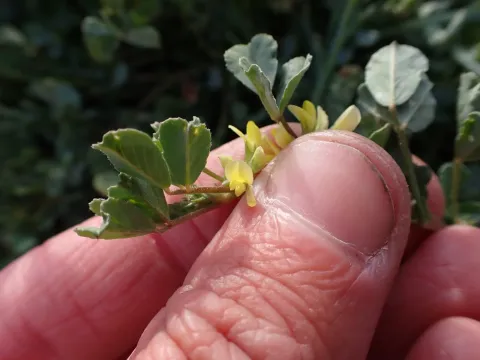
Sweet fenugreek
Trigonella suavissima
Sweet fenugreek (Trigonella suavissima) is a valuable herbaceous plant belonging to the Fabaceae family, recognized for its unique adaptation to arid environments.
What the section contains
Sweet fenugreek
The optimal time for sowing is during early spring once soil temperatures have risen sufficiently, allowing for consistent seed germination across the field.
Seeds should be sown at a shallow depth of approximately 1 to 2 centimeters to ensure they access adequate moisture while receiving enough warmth to break dormancy.
Maintaining proper row spacing, typically between 15 and 30 centimeters, is crucial to minimize competition for nutrients and water between individual plants.
A well-prepared seedbed, free of clods and weeds, significantly increases the initial stand density and overall success of the agricultural production cycle.
This crop thrives in sunny, well-ventilated conditions and is highly sensitive to excessive shading, which can inhibit its development and nutrient accumulation.
Sweet fenugreek prefers well-drained loamy or sandy soils that provide a balance between aeration and moisture retention for healthy root system expansion.
Although it exhibits strong drought tolerance, supplemental irrigation during the peak vegetative stage will result in significantly higher biomass yields.
The ideal soil pH for this species is near-neutral, as highly acidic or alkaline conditions may interfere with the nitrogen-fixing capabilities of root nodules.
Adequate management of nutrient levels, particularly phosphorus, is recommended to support robust growth and to maximize the plant's overall photosynthetic potential.
Sweet fenugreek is primarily valued as a forage crop, providing high-quality protein and essential minerals to livestock during periods of scarcity.
The forage yield depends heavily on site-specific management, with intensive cultivation methods yielding between 15 and 25 tons of green matter per hectare.
Beyond its forage value, the plant is studied for its chemical composition and its role as a sustainable legume crop in complex agricultural rotations.
Seed yields generally range from 0.5 to 1.2 tons per hectare, depending on local precipitation levels and the efficiency of harvest operations.
Its ability to survive and produce biomass in challenging climates makes it an excellent choice for improving agricultural land productivity in arid regions.
Like many legumes, sweet fenugreek is susceptible to root rot diseases, especially if cultivated in areas with poor drainage and excessive soil moisture.
Insect pests, including aphids and various weevils, often target young shoots and leaves, necessitating early identification and targeted management strategies.
Crop rotation remains the most effective cultural practice to disrupt the life cycles of soil-borne pathogens and to maintain long-term soil fertility.
In cases of severe infestation, the application of selective, environmentally safe pesticides is considered as part of an integrated pest management program.
Proper field hygiene and weed control are essential, as competing vegetation can harbour pests and restrict the airflow necessary to prevent fungal outbreaks.
The harvest for green forage should occur during the early flowering stage to ensure the highest protein concentration and digestibility for livestock.
For seed production, harvesting must be timed carefully when the pods change color to brown, ensuring that seeds are mature yet pods remain intact.
Mechanical harvesting requires precise calibration of equipment to reduce seed shattering and prevent significant yield losses during the cutting process.
Post-harvest drying is critical; the crop should be processed quickly to lower moisture content, preventing heat buildup and mold growth in storage.
Final cleaning of the harvested product is necessary to remove impurities, thereby ensuring the highest quality standards for marketing or future sowing.