
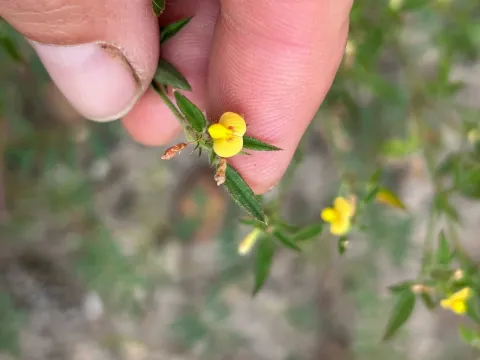
Stylosanthes
Stylosanthes Sw.
Stylosanthes (Stylosanthes Sw.) is a genus of herbaceous perennials and subshrubs belonging to the Fabaceae family. Known as "stylo" in agricultural circles, it is widely utilized for its ability to thrive in nutrient-poor tropical soils.
What the section contains
 Caribbean stylo
Stylosanthes hamata (L.) Taub.
Caribbean stylo
Stylosanthes hamata (L.) Taub.
 Intermediate stylo
Stylosanthes guianensis (Aubl.) Sw. var. intermedia (Vogel) Hassl.
Intermediate stylo
Stylosanthes guianensis (Aubl.) Sw. var. intermedia (Vogel) Hassl.
 Sticky stylo
Stylosanthes viscosa (L.) Sw.
Sticky stylo
Stylosanthes viscosa (L.) Sw.
 Stylosanthes capitata
 Vogel
Stylosanthes guianensis
Stylosanthes guianensis (Aubl.) Sw.
Stylosanthes capitata
Stylosanthes capitata Vogel
Stylosanthes guianensis
Stylosanthes guianensis (Aubl.) Sw.
 Stylosanthes macrocephala
 M.B. Ferr. & S. Costa
Stylosanthes macrocephala
Stylosanthes macrocephala M.B. Ferr. & S. Costa
 Stylosanthes scabra
 Vogel
Stylosanthes seabrana
Stylosanthes seabrana B. L. Maass & ʼt Mannetje
Stylosanthes scabra
Stylosanthes scabra Vogel
Stylosanthes seabrana
Stylosanthes seabrana B. L. Maass & ʼt Mannetje
 Townsville stylo
Stylosanthes humilis Kunth
Townsville stylo
Stylosanthes humilis Kunth
Stylosanthes
Originating from the tropical and subtropical regions of Central and South America, the crop has become naturalized in parts of Australia, Africa, and Asia. It is valued primarily for its drought tolerance and robust growth in marginal land conditions.
The plant features a deep taproot system, which helps it access water stored in lower soil layers. Its growth habit ranges from erect stems to prostrate, spreading forms, allowing it to compete effectively with weeds in some environments.
Stylosanthes demands well-drained soil. It is particularly well-suited to acid soils with low phosphorus levels, although its yield potential significantly increases with phosphorus fertilization. It cannot tolerate waterlogging, which often leads to root diseases.
The climate requirement is strictly tropical, favoring temperatures between 25°C and 30°C. It has very low frost tolerance and is not suitable for cultivation in regions with significant temperature drops during the winter season.
The primary use of Stylosanthes is as a high-quality forage crop for cattle and small ruminants. Its ability to fix atmospheric nitrogen improves soil fertility, making it an excellent component for integrated farming and silvopastoral systems.
Annual yields of dry matter typically range from 5 to 15 tons per hectare. This variation depends heavily on local rainfall patterns, soil type, and the management practices employed, including the use of fertilizers.
As a pasture plant, it is known for high palatability and nutritional value, especially its protein content. Grazing management is essential, as overgrazing can deplete the seed bank, while undergrazing may result in woody, less digestible stems.
Stylosanthes is also used for soil conservation. Its dense canopy reduces the impact of heavy tropical rains, thereby preventing surface runoff and soil erosion on hilly terrain where other crops might fail.
In addition to fresh grazing, it can be harvested for hay. When cured properly, it provides a stable source of nutrients for livestock during dry seasons when the availability of green grass is naturally low.
Anthracnose, caused by the fungus Colletotrichum gloeosporioides, is the most serious disease affecting Stylosanthes. It can cause severe defoliation and plant death, making the selection of resistant cultivars a necessity.
Insect pests, including leaf-eating caterpillars and aphids, pose a consistent threat to the foliage. These pests can rapidly defoliate large areas, especially during the peak of the growing season when the plant is most vulnerable.
Slow seedling establishment is a significant hurdle for farmers. During the first few weeks, the young plants are easily outcompeted by aggressive weeds, necessitating careful site preparation and weed management.
Root-knot nematodes can also cause substantial yield losses by damaging the root systems, thereby inhibiting nutrient uptake and nitrogen fixation efficiency. This is often more prevalent in fields with continuous monocropping.
- Monitoring for necrotic spots on stems and leaves.
- Utilizing resistant varieties like 'Seca' or 'Siran'.
- Maintaining proper soil drainage to limit fungal spread.
- Implementing effective weed control during the seedling stage.