
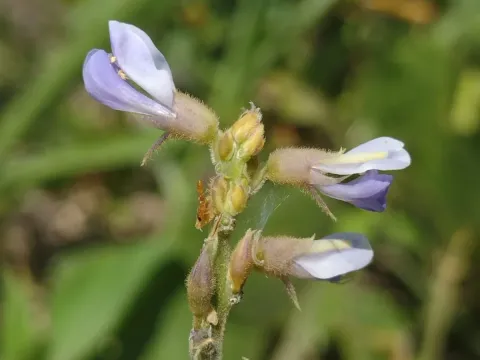
Calopogonium caeruleum
Calopogonium caeruleum
Sowing of Calopogonium caeruleum is typically performed at the onset of the wet season when the soil is warm and moisture levels are high. This timing ensures rapid germination and successful establishment of the seedlings.
What the section contains
Calopogonium caeruleum
Seeds often require scarification to break their hard coat, which significantly improves the germination rate and ensures uniform plant emergence. The recommended sowing depth is 2–3 cm into prepared, moist soil.
The crop grows rapidly to form a dense cover, which is highly effective in suppressing weeds during the early developmental stages. Proper seeding density is crucial to prevent weed invasion and promote high biomass production.
During the first few weeks, it is recommended to keep the field clear of aggressive weeds until the Calopogonium forms a closed canopy. Once established, it acts as a permanent, living mulch layer.
Agronomists suggest mixing the seeds with other legumes or grasses in specific environments to create a more diverse and resilient cover that maximizes soil health benefits across various climatic cycles.
Calopogonium caeruleum is a perennial trailing vine belonging to the Fabaceae family, native to tropical regions of Central and South America. It is recognized for its vigorous growth habit and ability to root at the nodes, creating a thick mat on the soil surface.
The plant thrives in warm, humid tropical climates but demonstrates remarkable tolerance to short periods of drought. It grows optimally within temperature ranges of 25 to 30 degrees Celsius.
This species is highly adaptable to various soil types, including acidic and nutrient-poor soils where other crops might struggle. Its shade tolerance makes it an excellent choice for planting in orchards and rubber or oil palm plantations.
A key biological feature of this crop is its ability to fix atmospheric nitrogen through a symbiotic relationship with specific soil bacteria. This process significantly improves the nitrogen profile of the soil for subsequent crops.
While the plant requires good soil aeration, it can withstand occasional waterlogging, making it a reliable and versatile species for use in diverse tropical landscapes.
The primary use of Calopogonium caeruleum is as a cover crop and green manure, aimed at protecting soil from erosion and improving its chemical and physical structure. It generates substantial organic matter.
In plantation management, the vines are periodically slashed to provide mulch, which maintains soil moisture, regulates temperature, and supplies nutrients to the tree roots. This practice is essential for sustainable agriculture.
The accumulation of biomass is rapid, leading to improved soil friability and fertility. In many cases, it serves as a long-term investment in soil health, significantly increasing the potential yield of primary commercial crops.
Peak performance is generally reached in the second year, when the plant forms a lush carpet up to 50 cm tall. Regular management helps in maintaining this high-yield biomass production over multiple seasons.
Strategic slashing and trimming not only provide an immediate source of nutrients to the soil but also stimulate regrowth and keep the plants in a vegetative state, maximizing the nitrogen-fixation cycle.
Although robust, the crop can be susceptible to fungal diseases such as powdery mildew or various leaf spots, particularly in areas with excessive humidity and limited airflow. Maintaining stand density is vital for health.
Insects may occasionally damage leaves and young shoots, though significant economic loss is rare. Root-knot nematodes can pose a problem in cases of poor crop rotation, necessitating careful management of the plantation history.
Preventative measures include using high-quality disease-free seeds and ensuring proper spacing between plants to encourage good ventilation, which limits the development of pathogens.
- Fungal infections (leaf spots, anthracnose).
- Root-knot nematode infestation.
- Feeding by leaf-eating insects.
Effective management, including the regular removal of severely affected vines and proper sanitation, keeps pest and disease populations at levels that do not interfere with the crop’s soil-improving functions.