
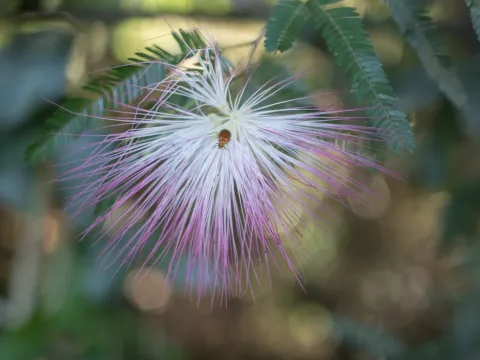
Calliandra
Calliandra Benth.
The sowing of Calliandra seeds for commercial purposes, such as establishing shelterbelts or fodder plantations, is typically performed at the beginning of the rainy season. Seeds require scarification to improve germination rates due to their hard seed coat.
What the section contains


Calliandra
When planting in permanent locations, it is recommended to use two-to-three-month-old seedlings grown in containers. This ensures better survival rates for young plants in field conditions compared to direct seeding.
The optimal planting pattern depends on the cultivation goals. For hedge or ground cover establishment, the spacing between plants ranges from 0.5 to 1 meter, facilitating the formation of a dense physical barrier.
In intensive agricultural systems, planting is performed in rows with inter-row spacing of up to 2 meters. This allows for easy machinery access and ensures adequate light penetration for each plant throughout the growth cycle.
Following planting, regular irrigation is required for the first few months until the root system is well-established. Calliandra grows actively in temperatures between 20 and 30 degrees Celsius and with stable moisture levels.
Calliandra belongs to the Fabaceae family and is a fast-growing shrub or small tree. The plant is highly valued for its ability to fix atmospheric nitrogen, which significantly improves soil fertility.
The crop prefers well-drained soils with a neutral or slightly acidic reaction. It is extremely sensitive to waterlogging; therefore, growth is significantly stunted in saturated soil conditions.
The plant adapts well to poor soils, demonstrating high drought tolerance once the active rooting stage is completed. It grows successfully under partial shade, but produces maximum biomass in full sun.
Agricultural management requires periodic pruning of the shrub, which stimulates lateral shoot growth and increases canopy density. Pruning is also used to control the plant's height when utilized as green manure.
Calliandra does not tolerate frost, restricting its cultivation to tropical and subtropical regions. The optimal annual rainfall for intensive growth ranges from 1000 to 3000 mm.
The green biomass yield of Calliandra can reach 10–20 tonnes of dry matter per hectare annually under proper management. This makes it one of the most productive crops for tropical fodder systems.
Maximum productivity is achieved through regular harvesting of shoots, which prevents stem lignification and keeps the plant in an active vegetative growth phase. Harvesting frequency depends on local climatic conditions.
The crop also provides significant value through seed production, which can be harvested for plant propagation. Seed yields are influenced by pollinator activity and the overall health of the plantation.
When used as a cover crop, productivity is evaluated not by weight, but by the volume of accumulated organic matter, which feeds primary crops after decomposition.
The economic impact of Calliandra is enhanced by substantial savings on mineral nitrogen fertilizers, thanks to the symbiotic activity of root nodule bacteria that fix nitrogen from the air.
Calliandra generally possesses high disease resistance; however, in conditions of high humidity, it may be susceptible to fungal diseases such as powdery mildew or root rot.
Regarding pests, leaf-eating insects pose the greatest risk, especially during the plant's early growth stages. Foliage damage reduces photosynthesis rates and slows biomass accumulation.
To minimize infection risks, it is necessary to maintain proper irrigation regimes and ensure good airflow between plants. High-density planting is generally discouraged.
In the event of mass pest outbreaks, the use of biological control agents is preferred over chemical methods, as the biomass is often utilized as livestock fodder.
Timely sanitary pruning of infected shoots is a key preventative method to stop the spread of infections within the plantation.
Harvesting Calliandra biomass is carried out through manual or mechanized pruning. The first harvest is usually possible within 6 to 9 months after planting in the permanent field.
For fodder purposes, harvesting is conducted at a height of 30–50 cm from the ground. This allows the plant to recover quickly using dormant buds located on the lower part of the stems.
After harvesting, fresh biomass can be fed directly to livestock or dried. Drying is necessary for the long-term storage of hay, which maintains a high protein content.
When used as mulch or green manure, shoots are shredded and distributed directly over the soil surface between rows of the main crop for subsequent incorporation into the soil.
Harvesting frequency directly impacts forage quality: the younger the shoots, the higher the protein content and the lower the concentration of tannins, which can interfere with animal digestion.