
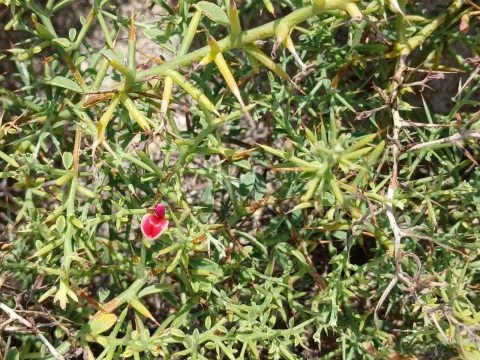
Camelthorn
Alhagi graecorum
Camelthorn (Alhagi graecorum) is a perennial shrub belonging to the Fabaceae family. It is widely recognized for its extreme resilience in arid and semi-arid environments across its native range.
What the section contains
Camelthorn
The plant thrives in a variety of soil types, including sandy, stony, and saline substrates. Its survival mechanism is largely dependent on an extensive root system that can reach deep into the soil profile to access groundwater.
Climate requirements for this plant are stringent regarding light and heat; it thrives under high solar radiation and low relative humidity. It does not tolerate shade or poorly drained soils, as these conditions inhibit its growth.
From an agricultural standpoint, managing this plant involves balancing its utility as livestock fodder with its tendency to become an invasive weed in cultivated crop fields.
Economically, it serves as a crucial food source for camels and goats in desert regions, and it is a significant nectar source for bees, producing high-quality honey in specialized habitats.
As a weed, Camelthorn poses significant threats to agricultural productivity, particularly in areas with irrigation, where it competes aggressively for water and nutrients.
Pathogens affecting the plant include various leaf-spotting fungi, though these rarely cause significant damage to the plant's overall health due to its robust nature.
Insect pests, such as weevils and seed-feeding larvae, can negatively impact seed production, which serves as a natural biological control by limiting the plant's spread.
Control measures are difficult to implement due to the plant's ability to regenerate from fragmented root segments. Intensive tillage is often necessary to deplete the stored energy in its deep root system.
Integrated pest management strategies are recommended, combining chemical applications with cultural practices such as crop rotation and the use of competitive cover crops to suppress its development.