
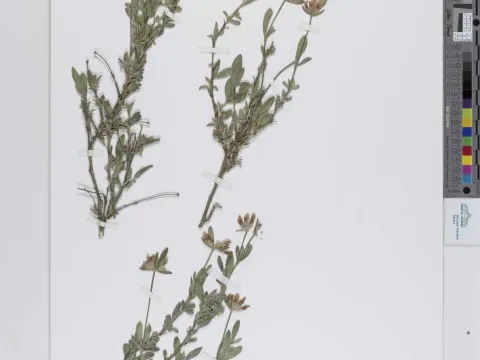
Anthyllis lagascana
Anthyllis lagascana
Anthyllis lagascana belongs to the Fabaceae family, a group of plants highly valued for their role in nitrogen fixation and soil health. It is a perennial herbaceous plant known for its structural stability in arid environments.
What the section contains
Anthyllis lagascana
Sowing should be carried out in early spring when the soil temperature consistently reaches 10 degrees Celsius. Drilling or line-seeding with rows spaced 20 cm apart is recommended to ensure optimal plant density and individual development.
Seeds should be planted at a depth of 1-2 cm. Providing adequate soil moisture during the germination phase is essential, as this helps achieve uniform emergence and prevents early-stage seedling mortality.
Following germination, the plant focuses on establishing a strong taproot, which is characteristic of the genus Anthyllis. This root system allows the plant to access deep soil moisture during the hot summer months.
Scarification of seeds prior to sowing is a recommended agronomic practice to break dormancy and improve germination rates, resulting in a more productive and consistent crop stand from the very first season.
This species thrives in well-lit environments, preferring full sun exposure throughout the day. Sufficient solar radiation is crucial for the photosynthesis of its foliage and the subsequent development of its flowering structures.
Regarding soil preferences, Anthyllis lagascana adapts well to light-textured, well-drained soils, such as sandy loams or calcareous substrates. It is sensitive to waterlogging, so effective soil drainage is a prerequisite for success.
The plant exhibits remarkable drought tolerance, which is supported by its deep root architecture. This makes it an ideal candidate for erosion control on slopes and for rehabilitating degraded or nutrient-poor agricultural land.
Optimal growth occurs at temperatures ranging between 18 and 25 degrees Celsius. While it can withstand fluctuations, prolonged exposure to extreme frost or excessive heat can slow down the development of secondary stems.
Fertilization requirements are generally low, as the plant engages in symbiotic relationships with nitrogen-fixing bacteria. Supplementary phosphorus and potassium can be added to improve overall yield and disease resistance.
The primary pathological threats include fungal infections like root rots and various leaf spots, which are typically exacerbated by high humidity or poor air circulation within the canopy of the crop.
Pests such as pea leaf weevils are known to damage the foliage and roots of young plants. Monitoring populations and implementing preventative measures during the seedling phase is vital for crop protection.
Aphid infestations can occur during the flowering stage, potentially weakening the plant and affecting seed production. Biological control methods are often sufficient to keep these populations below the economic threshold.
Weed management in the early stages is necessary to ensure the crop has access to sufficient resources. Mechanical inter-row cultivation is highly effective and minimizes the need for chemical herbicides.
To prevent disease spread, it is advisable to avoid planting Anthyllis lagascana in fields where other legumes have been recently cultivated, as this helps break the lifecycle of specific legume-targeted pathogens.