
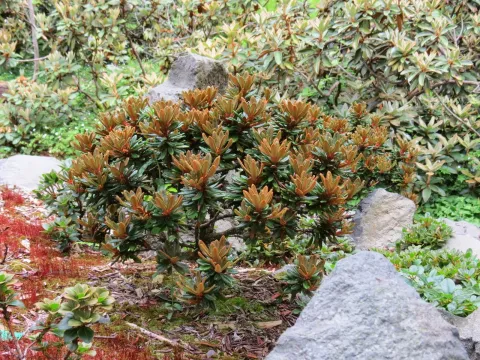
Dwarf rhododendron
Rhododendron pumilum
The dwarf rhododendron (Rhododendron pumilum) belongs to the Ericaceae family. It is a slow-growing, evergreen subshrub that reaches heights of only a few centimeters, forming compact cushions that hug the ground. Native to high-altitude regions of the Himalayas, Tibet, and Western China, it is perfectly adapted to alpine environments.
What the section contains
Dwarf rhododendron
Botanically, it is distinguished by its small, elliptical, leathery leaves and relatively large, bell-shaped, pink-to-purple flowers. This species is highly prized by alpine enthusiasts for its ability to produce a massive display of flowers that completely obscures the foliage during the late spring blooming season.
In terms of climate, the species demands cool, moist conditions with consistent air circulation. It struggles significantly in low-altitude gardens with hot, dry summers. Providing a site with partial shade, preferably on a north-facing slope or near water features, helps maintain the necessary atmospheric humidity.
The soil requirements are strict: the medium must be acidic (pH 4.5–5.5), well-draining, and rich in organic matter. A mixture of peat, pine bark, and grit is usually necessary to mimic the natural scree or mossy turf habitats of the Himalayas where this plant originates.
Cultivation technique involves careful moisture management. While the plant hates "wet feet," the shallow root system must never be allowed to dry out completely. Mulching with acidic materials like pine needles is recommended to protect roots from temperature fluctuations and to maintain the soil's acidity.
The primary threats to Rhododendron pumilum are fungal pathogens, specifically Phytophthora, which causes root rot in poorly drained substrates. Additionally, leaf spot diseases can occur if the foliage remains wet for extended periods in stagnant air conditions.
Pests that commonly affect this plant include aphids and rhododendron lace bugs, which feed on the undersides of the leaves. Regular inspection and the use of targeted pest management strategies are essential to maintain the health and vigor of this delicate alpine species.