
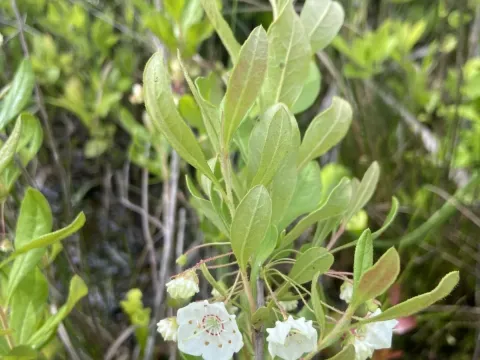
White wicky
Kalmia cuneata
Kalmia cuneata, commonly known as white wicky, is a deciduous shrub belonging to the Ericaceae family. It is natively restricted to specific pocosin and swampy habitats in North and South Carolina, USA, which dictates its precise environmental preferences.
What the section contains
White wicky
To cultivate this species successfully, growers must provide acidic soil conditions, typically ranging from pH 4.5 to 5.5. The growing medium should be highly organic, rich in peat moss, and provide excellent drainage to prevent root rot, which the plant is highly susceptible to.
The ideal planting site involves partial shade, as the shrub performs poorly under intense, direct sunlight. In its natural range, it benefits from the shelter of larger trees, which moderate both the light intensity and the local humidity levels around the foliage.
Cultural practices include the exclusive use of non-alkaline, soft water for irrigation. The shallow root system requires consistent moisture without saturation, making the addition of a thick layer of pine needle mulch essential for thermal regulation and moisture retention throughout the year.
Fertilization should be handled with extreme caution. The plant relies on ericoid mycorrhizal fungi to absorb nutrients, and excess synthetic fertilizers can damage these symbiotic relationships, ultimately weakening the shrub's health and reducing its flowering potential.
The primary pathological threats to Kalmia cuneata are fungal infections, most notably Phytophthora root rot. This disease is almost always linked to poor drainage or overly compacted soil, making prevention through site preparation the most effective defense mechanism.
Insect pests such as spider mites and scale insects can pose a significant threat during periods of hot, dry weather. These pests extract sap from the leaves and stems, leading to stunted growth, leaf chlorosis, and in severe cases, the death of individual branches.
Powdery mildew may occur if the shrub is planted in an area with stagnant air. To prevent this, spacing plants adequately and ensuring good site ventilation is crucial. If an infection is detected, systemic fungicides can be applied to stop the spread.
Soil-dwelling larvae, such as those of the Japanese beetle, can cause hidden damage to the delicate root system. Integrated pest management, including the use of beneficial nematodes or appropriate soil drenches, is recommended for plantations located in high-risk zones.
Maintaining optimal pH levels is not only a growth requirement but also a pest management strategy. Plants that are stressed by improper soil acidity or nutrient deficiencies are significantly more attractive to opportunistic pests and secondary fungal invaders than healthy, well-nourished specimens.