
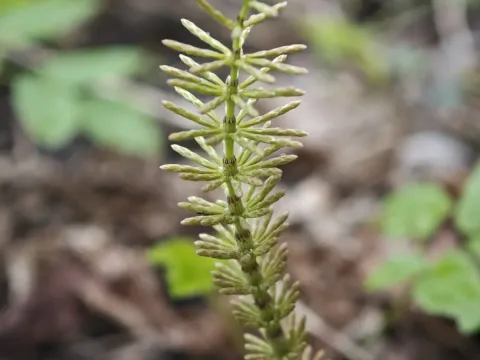
Meadow horsetail
Equisetum pratense
Meadow horsetail (Equisetum pratense) is a perennial spore-bearing vascular plant belonging to the Equisetaceae family. It is widely distributed across the northern hemisphere, favoring moist, cool habitats such as meadows, riverbanks, and woodland edges.
What the section contains
Meadow horsetail
The plant exhibits a distinct dimorphic growth pattern. In early spring, non-photosynthetic fertile shoots emerge to disperse spores, while sterile, green, and branched vegetative shoots appear later in the season to perform photosynthesis.
This species thrives in soils with adequate moisture and is known to be an indicator of specific environmental conditions, such as high soil acidity or poor drainage, which can be critical factors for land management and crop planning.
Morphologically, it is characterized by rigid stems rich in silica, which provides structural integrity and defense. The plant relies on an extensive underground rhizome system, which allows it to persist through seasonal changes and survive cold winter temperatures.
Agronomically, meadow horsetail is often considered an opportunistic species. Its presence in fields usually signals that the soil conditions, particularly pH and moisture levels, may need modification to favor more productive agricultural crops.
Due to the high silica content in its tissues, meadow horsetail is inherently resistant to many common agricultural pests. The harsh, abrasive nature of the stem surface makes it largely unpalatable to most herbivores and insects.
Fungal diseases are the primary natural threat to the species, particularly rusts and molds that can develop during prolonged rainy seasons. These pathogens can weaken the plant but rarely lead to the complete collapse of a colony.
The primary concern for farmers is the plant's aggressive vegetative reproduction. Fragmentation of rhizomes during tilling operations can lead to the proliferation of the plant rather than its elimination, making cultivation challenging.
Chemical control remains difficult due to the waxy cuticle of the stems, which resists the absorption of standard herbicides. Effective management requires the use of wetting agents to ensure proper contact and uptake of the treatment.
Successful management typically involves a combination of soil drainage improvements, liming to balance pH levels, and consistent mechanical disturbance that eventually depletes the energy reserves stored within the rhizomes.