
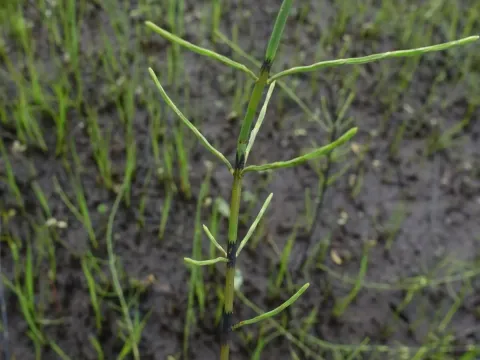
Dyce's horsetail
Equisetum dycei
Dyce's horsetail (Equisetum × dycei) is a perennial vascular plant and a natural hybrid between water horsetail (Equisetum fluviatile) and marsh horsetail (Equisetum palustre). As a member of the Equisetaceae family, it displays the characteristic jointed, silica-rich stems that define the genus.
What the section contains
Dyce's horsetail
The distribution of this hybrid is primarily concentrated in Northern Europe, specifically in regions where the parental species overlap. It is an obligate wetland plant, typically colonizing marshes, river banks, and wet meadows where hydric soil conditions persist throughout most of the year.
Morphologically, the plant is recognized by its hollow, photosynthetic stems that exhibit specific nodal sheath patterns. Its vegetative propagation is highly efficient due to a robust network of rhizomes, which allows it to form dense colonies in stable, moist substrates that other plants might find too waterlogged.
Regarding site requirements, Dyce's horsetail thrives in damp, acidic to neutral soil types. It is particularly well-adapted to high water tables, making it an excellent candidate for stabilizing riparian zones where sediment erosion is a primary concern for land management and ecological restoration.
The environmental tolerance of this species is quite broad concerning light exposure, as it can grow in both open sunny areas and partial shade. However, successful establishment is strictly contingent upon moisture availability; prolonged drought periods will lead to rapid senescence and potential loss of the local population.