
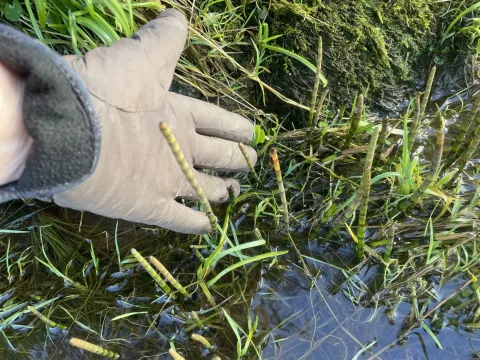
Water horsetail
Equisetum fluviatile
Water horsetail (Equisetum fluviatile) is a perennial sporophyte belonging to the Equisetaceae family. This species is unique for its preference for aquatic habitats, often found in shallow waters and marshes across temperate regions.
What the section contains
Water horsetail
The plant originates from the Northern Hemisphere, spanning across Europe, Asia, and North America. It thrives in stagnant or slow-moving water, where it creates dense stands through an extensive network of underground rhizomes.
Requirements for growth include high soil moisture levels and consistent water availability. Unlike terrestrial horsetails, this species is adapted to survive complete inundation, making it suitable for wet agricultural zones.
Agrotechnical management focuses on maintaining water levels and monitoring soil pH, which should ideally be slightly acidic to neutral for optimal biomass production.
The species serves various purposes, including being a source of silica for industrial applications and a traditional remedy. In livestock management, it is sometimes used as forage, provided that processing minimizes the risk of toxicity.
Due to the high silica content in its stem tissues, Equisetum fluviatile is generally resilient against many common fungal pathogens that affect other soft-stemmed crops.
However, environmental stress caused by sudden changes in water levels can lead to tissue decay, making the rhizome system susceptible to opportunistic soil-borne rot.
Insect pests such as certain aphids and larvae of aquatic insects can sometimes feed on the soft shoots, although these incidents rarely reach the threshold of economic damage.
Industrial pollution of wetlands poses a significant threat, as the plant acts as a bioaccumulator, absorbing contaminants from water and substrate, which limits its safe use for fodder.
Competition from invasive aquatic macrophytes represents a major long-term threat to the density and health of water horsetail stands in managed or natural settings.