
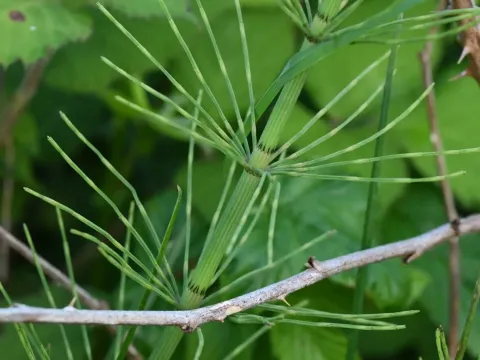
Shore horsetail
Equisetum litorale
Shore horsetail (Equisetum litorale) is a perennial pteridophyte belonging to the Equisetaceae family. It is a well-documented natural hybrid resulting from the crossing of Equisetum arvense and Equisetum fluviatile, exhibiting intermediate traits of both parent species.
What the section contains
Shore horsetail
This species is found in temperate regions across the Northern Hemisphere. It thrives in wetland environments, including riverbanks, marshy meadows, and areas characterized by high water tables.
The plant requires consistently moist soils for optimal growth, preferring sandy or silty substrates with a neutral to slightly acidic pH level. It is highly adapted to areas that experience periodic flooding throughout the growing season.
Its rhizomatous root system is deep and extensive, enabling the plant to establish itself firmly in damp environments and survive seasonal climate shifts effectively.
Botanically, it is recognized by its slender, ribbed stems and its ability to reproduce, though its spore fertility is often limited due to its hybrid nature, leading to a reliance on vegetative propagation.
Equisetum litorale possesses significant physical defenses, such as high silica content in its cell walls, which makes it largely unpalatable and resistant to many typical agricultural pests.
The primary biotic threats include various fungal pathogens that flourish in stagnant, waterlogged conditions, potentially causing stem decay and weakening the plant's structural integrity.
In agricultural settings, it can be considered a difficult weed due to its resilient rhizomes, which are resistant to physical removal and require targeted management strategies.
The primary abiotic threat to its survival is the drainage of wetlands, as the plant cannot survive in dry or well-drained upland soil conditions over long periods.
Competition from more aggressive, fast-growing hydrophytic plants can suppress the growth of shore horsetail populations in environments where nutrient availability is high.