
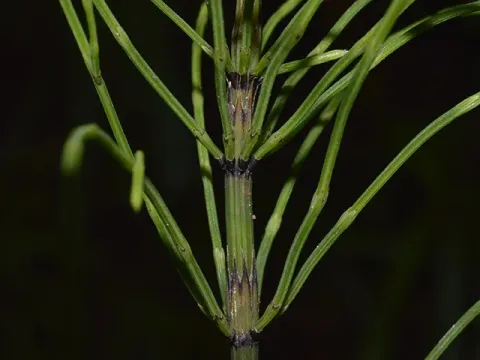
Spreading horsetail
Equisetum diffusum
Spreading horsetail (Equisetum diffusum) is a perennial vascular cryptogam belonging to the family Equisetaceae. It is distinct for its spreading growth habit, which allows it to form dense colonies in stable environments.
What the section contains
Spreading horsetail
The species is primarily distributed across the mountainous regions of Asia, including the Himalayas and various parts of China and India. It thrives in high-humidity areas, often found along stream banks and near waterfalls where water is consistently present.
This plant has specific requirements for soil conditions, preferring substrates that are mineral-rich and moisture-retentive. It grows best in conditions where the pH levels are slightly acidic to neutral, avoiding highly alkaline or compacted soils.
Botanically, Equisetum diffusum is characterized by its high silica content, which provides structural integrity and defense against many herbivores. Its underground rhizomes are highly resilient, allowing the plant to survive harsh winter conditions in mountain habitats.
While not a traditional food crop, the plant holds value in ecological restoration projects. Its root system is exceptionally effective at binding soil on steep, wet slopes, thereby playing a critical role in preventing soil erosion and stabilizing stream banks.
Habitat loss due to hydro-engineering projects represents the most significant threat to the spreading horsetail. Since the plant relies on consistent water flow, any disruption to its natural hydration source can lead to rapid population decline.
Pathogenic fungi are known to affect Equisetum diffusum when drainage is poor. Stagnant moisture can lead to stem rot, which compromises the integrity of the silica-rich stalks and reduces the plant's ability to regenerate via spores.
Insect pests are generally few due to the abrasive nature of the plant's silica-coated surface. However, specific types of sap-sucking insects may colonize young shoots during the early stages of the growing season, causing stunted growth.
Climate change, manifesting as increased temperatures and reduced rainfall in mountainous regions, poses a long-term risk. The species is highly sensitive to moisture stress and may struggle to adapt to prolonged periods of drought.
Competition from non-native invasive plant species is also an increasing threat. In disturbed ecosystems, aggressive weeds often outcompete the slower-growing spreading horsetail, leading to the fragmentation of its naturally resilient habitats.