
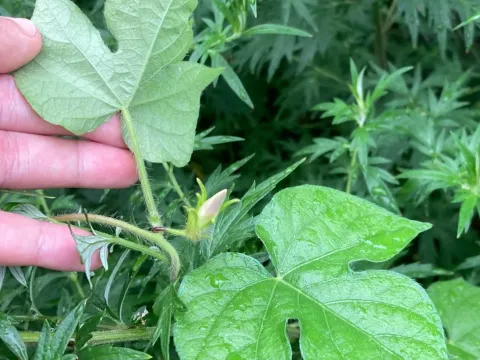
Ivy-leaved morning glory
Ipomoea hederacea
Seeds of the ivy-leaved morning glory require soil temperatures of at least 15 to 18 degrees Celsius for germination. Peak germination activity occurs during the late spring months.
What the section contains
Ivy-leaved morning glory
The species demonstrates high seed dormancy, allowing it to survive in the soil bank for several years. Germination depth generally ranges from 1 to 5 centimeters depending on soil texture.
In cropping systems like corn or soybean, emergence typically peaks in June. Early identification is crucial for effective management before the plant starts twining.
Mechanical cultivation remains the primary method for controlling seedlings. Repeated flushes of emergence are common, especially following significant summer rainfall events.
The plant grows rapidly during the hot summer months, quickly reaching its reproductive phase if not managed properly by agricultural producers.
Belonging to the Convolvulaceae family, this plant thrives in warm, sunny environments with fertile, well-drained soils. It is native to tropical America.
The species is highly sensitive to frost and low temperatures, which restricts its active growth to the frost-free season. Optimal soil pH for growth is between 6.0 and 7.5.
Botanically, the plant is characterized by its twining stems and ivy-like, three-lobed leaves. It relies on other structures or crops for vertical support to maximize light exposure.
Water availability significantly impacts growth rates; while it shows some drought tolerance, consistent moisture leads to more aggressive vine expansion.
Effective management requires maintaining competitive crop canopies, as the morning glory is poorly adapted to shaded environments under dense foliage.
The species is susceptible to various fungal pathogens, including white rust and leaf spot diseases, which flourish under high humidity conditions.
Insects such as aphids, spider mites, and flea beetles are common pests that cause significant damage to leaves and stems by sucking sap or consuming foliage.
Some Lepidoptera species can cause substantial leaf defoliation, though this is often not enough to control the weed population effectively in large fields.
Viral infections transmitted by insect vectors can cause stunted growth or distorted leaves in the ivy-leaved morning glory population.
Integrated pest management strategies, involving both herbicides and biological controls, are necessary to prevent the plant from becoming a dominant weed in agricultural systems.