
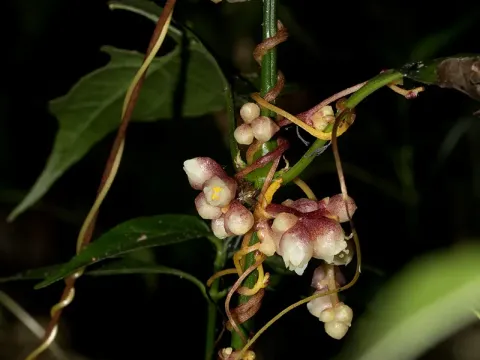
Kilimanjaro dodder
Cuscuta kilimanjari
Kilimanjaro dodder (Cuscuta kilimanjari) is a parasitic plant species belonging to the Convolvulaceae family. Unlike conventional agricultural crops, it is a holoparasite, meaning it lacks chlorophyll and roots, relying entirely on a host plant for survival.
What the section contains
Kilimanjaro dodder
The native range of this species is confined to high-altitude ecosystems in East Africa, particularly the slopes of Mount Kilimanjaro. It is adapted to the specific climate conditions of high tropical mountains, characterized by significant humidity and distinct temperature regimes.
Botanically, it consists of slender, leafless stems that entwine the host. It establishes a physiological connection with the host through structures known as haustoria, which penetrate the vascular tissues of the host plant to absorb water and nutrients.
There is no agricultural use for this plant; instead, it is recognized as a harmful parasitic organism. It serves no commercial purpose and is generally managed as a weed or a quarantine threat in regions where it is not native.
Environmental requirements include a consistent supply of moisture and suitable host plants that can sustain the parasite's energy needs throughout its growth cycle.
The primary threat posed by Cuscuta kilimanjari is the significant damage it inflicts on its host. By leaching nutrients, the parasite weakens host plants, reduces their biomass, and can eventually lead to death, threatening both crop yields and wild plant biodiversity.
The species is highly invasive due to its ability to spread via tiny, long-lived seeds. Furthermore, small stem fragments can attach to new hosts, facilitating the rapid expansion of a parasitic colony within a given area.
Management strategies involve strict quarantine measures to prevent the spread of seeds via contaminated farm equipment or seed stocks. Mechanical control often involves the destruction of entire patches of infected host plants to break the life cycle.
Specific diseases of the dodder are not well-documented, but it can be affected by various environmental stressors. However, as an aggressive parasite, it generally outcompetes native flora in its specific ecological niches.
Integrated pest management remains the most effective approach, focusing on early detection and physical removal to prevent the established population from reaching the seed production stage, thereby protecting surrounding vegetation.