
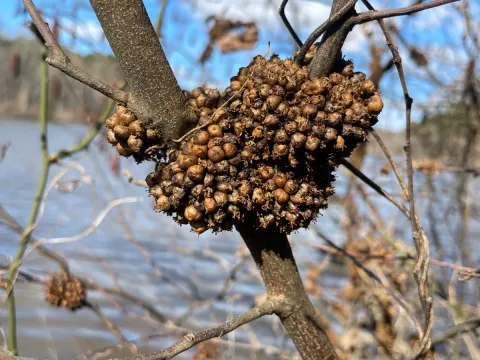
Compact dodder
Cuscuta compacta
Compact dodder (Cuscuta compacta) belongs to the Convolvulaceae family. It is an obligate holoparasitic plant, meaning it relies entirely on its host for water and nutrients, having lost the ability to photosynthesize effectively due to a lack of chlorophyll.
What the section contains
Compact dodder
The native range of this species is primarily in North America. It thrives in moist habitats, such as wetlands and forest margins, where there is an abundance of host species such as shrubs and trees that it can attach to for survival.
Botanical features are distinct; the plant consists of a mass of yellow or orange stems that wrap tightly around the host. It utilizes specialized organs called haustoria, which penetrate the host's vascular tissues to extract resources directly from the phloem and xylem.
Climatic requirements focus on humidity and thermal stability. The species requires warm growing seasons and high moisture levels to expand its range, which explains its preference for humid microclimates where vegetative density is high.
There is no positive economic utility for this plant. In agricultural and forestry sectors, the compact dodder is considered a serious nuisance and a quarantine pest that requires strict management to prevent its encroachment into managed landscapes.
The primary threat is the physiological drain on the host plant. By siphoning off nutrients and water, the dodder inhibits the host's growth, disrupts its reproductive cycle, and often causes branch dieback or total death of the infested organism.
Beyond direct feeding, the compact dodder is a known vector for various plant viruses. As it links multiple hosts through its stems, it creates a bridge for viral pathogens to spread throughout a community of plants quickly.
Control strategies involve strict sanitation practices and rigorous inspections of plant materials being imported. Identifying the weed before it produces seeds is critical, as its seeds are highly persistent and can survive in the soil for many years.
Mechanical destruction is the most effective approach for small-scale infestations. This involves cutting and burning the infected plant parts to ensure that no fragments of the dodder remain, as even small pieces can potentially reattach to new hosts.
Chemical control via selective herbicides is challenging because the parasite is intimately connected to the host. Research focuses on preventing host attachment rather than curing an existing infestation, making early detection the cornerstone of any management plan.