
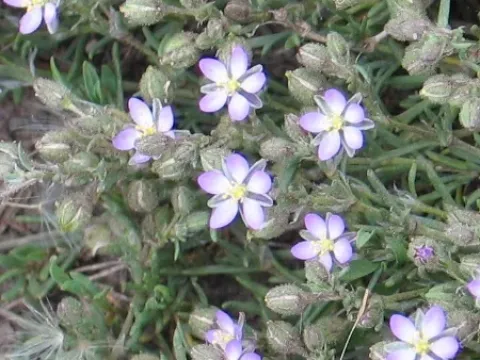
Sandspurry
Spergularia
Sandspurry, belonging to the Caryophyllaceae family, is rarely used as a primary agricultural crop, often appearing as a natural component of pastures or as a weed. In agricultural practice, sowing is performed in early spring or before winter in regions with mild climates.
What the section contains
 Boccone's sandspurry
Spergularia bocconei
Boccone's sandspurry
Spergularia bocconei
 Corn spurrey
Spergularia segetalis
Corn spurrey
Spergularia segetalis
 Fimbriate sandspurry
Spergularia fimbriata
Fimbriate sandspurry
Spergularia fimbriata
 Greater Sea-spurrey
Spergularia media
Greater Sea-spurrey
Spergularia media
 Lesser sea spurrey
Spergularia marina
Lesser sea spurrey
Spergularia marina
 Nicaean sandspurry
Spergularia nicaeensis
Nicaean sandspurry
Spergularia nicaeensis
 Purple sandspurry
Spergularia purpurea
Purple sandspurry
Spergularia purpurea
 Red sandspurry
Spergularia rubra
Sand spurrey
Spergularia diandra
Southern sandspurry
Spergularia australis
Red sandspurry
Spergularia rubra
Sand spurrey
Spergularia diandra
Southern sandspurry
Spergularia australis
 Spergularia azorica
Spergularia capillacea
Spergularia capillacea
Spergularia embergeri
Spergularia embergeri
Spergularia azorica
Spergularia azorica
Spergularia capillacea
Spergularia capillacea
Spergularia embergeri
Spergularia embergeri
 Spergularia flaccida
Spergularia flaccida
Spergularia flaccida
 Spergularia heldreichii
Spergularia heldreichii
Spergularia heldreichii
 Spergularia macrorrhiza
Spergularia pitardiana
Spergularia pitardiana
Spergularia platensis
Spergularia platensis
Spergularia macrorrhiza
Spergularia macrorrhiza
Spergularia pitardiana
Spergularia pitardiana
Spergularia platensis
Spergularia platensis
 Spurry
Spergularia echinosperma
Spurry
Spergularia echinosperma
 Tangerine sandspurry
Spergularia tangerina
Tangerine sandspurry
Spergularia tangerina
Sandspurry
The seeds of sandspurry have a high germination capacity at minimal soil temperatures. Sowing into warm, moderately moist soil is considered optimal, which allows the plant to quickly occupy the available space.
The seeding rate depends on the intended use: for pasture establishment, it is significantly lower than when using the crop for the phytoremediation of saline lands. It is important to ensure shallow seed coverage, as they are sensitive to sowing depth.
In natural conditions, reproduction occurs through self-seeding, which makes the crop extremely aggressive. With intentional cultivation, it is important to monitor maturation times to avoid uncontrolled spread to neighboring areas.
The vegetation period of sandspurry is relatively short, allowing the crop to successfully complete its life cycle before the onset of peak summer droughts or autumn frosts.
Sandspurry is a typical halophyte, capable of tolerating high concentrations of salts in the soil solution. It grows successfully in sandy, nutrient-poor soils where other species cannot survive.
The crop is extremely undemanding regarding the particle size distribution of the soil, but it prefers well-aerated substrates. High resistance to physiological dryness allows the plant to develop on coastal areas.
The plant is adapted to a wide range of climatic conditions, withstanding both significant temperature fluctuations and moisture deficits. However, the most intense growth is observed under moderate humidity.
Sandspurry has high light requirements: it is a light-loving plant that is suppressed under dense shade. It handles direct sunlight and intense ultraviolet radiation excellently.
The agronomy requires minimal investment, as the plant is competitive in extreme conditions. Basic maintenance consists of regulating the water regime during periods of abnormal drought.
The economic productivity of sandspurry as a fodder crop is low compared to traditional grasses. The green mass has satisfactory nutritional properties in the pre-flowering phase.
The yield of green mass strongly depends on the degree of soil salinity and the level of moisture. In favorable conditions, it is possible to obtain two cuttings in a single vegetation period.
The use of the plant is justified on marginal lands unsuitable for classical farming. Here, sandspurry provides a stable, albeit small, volume of biomass for livestock grazing.
Nutritional value decreases after the onset of the fruiting phase when the stems become coarse. Therefore, harvesting for hay requires timely cutting before seed formation begins.
A promising direction is the use of sandspurry as a component of grass mixtures for the recultivation of degraded saline territories.
Sandspurry has high resistance to diseases characteristic of most field crops. In rare cases, in waterlogged soils, the development of root rots may occur.
Pests specialized in attacking sandspurry are rarely encountered, which allows the crop to be grown with almost no pesticide use. The main threat is posed by general-type insect phytophages.
The weedy nature of the plant makes it a competitor for sensitive crops, so in intensive crop rotation, sandspurry is considered an object for control. The application of broad-spectrum herbicides is effective against this family.
Damage caused by fungal infections is most often secondary and occurs against the background of general plant weakening due to unfavorable growth conditions.
Monitoring the phytosanitary status of crops is mainly necessary to prevent the spread of infections to more valuable neighboring agricultural crops.
Harvesting the green mass of sandspurry is carried out using traditional mowers. The optimal time is the budding period, when the plant contains the maximum amount of protein.
For seed purposes, harvesting is conducted when the seed capsules darken, trying to avoid their cracking and seed shattering in the field. Combining requires careful adjustment of the threshing unit clearance.
Post-harvest seed processing includes drying and cleaning from plant residues, as the plant seeds are very small and require the use of specialized sieves.
Storage of the harvested mass should be carried out in well-ventilated rooms to prevent self-heating and mold development. Hay from sandspurry retains its structure well if dried properly.
Timeliness of harvesting is critically important, as quality drops sharply if left too long, and the risk of massive self-seeding in the field increases significantly.