
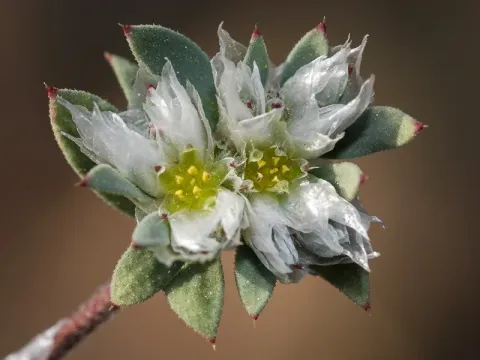
Paronychia
Paronychia
Sowing Paronychia seeds in open ground is best carried out in the spring, once the soil has warmed sufficiently, typically in April or early May. The seeds exhibit high germination rates, although stratification is often beneficial for more uniform growth in cases of late-autumn sowing.
What the section contains
 Albanian whitlow-wort
Paronychia albanica
Albanian whitlow-wort
Paronychia albanica
 Canada nailwort
Paronychia canadensis
Moroccan whitlow-wort
Paronychia maroccana
Canada nailwort
Paronychia canadensis
Moroccan whitlow-wort
Paronychia maroccana
 Paronychia arabica
Paronychia arabica
Paronychia arabica
 Paronychia aretioides
Paronychia aretioides
Paronychia aretioides
 Paronychia brasiliana
Paronychia brasiliana
Paronychia brasiliana
 Paronychia capitata
Paronychia capitata
Paronychia capitata
 Paronychia cephalotes
Paronychia cephalotes
Paronychia cephalotes
 Paronychia chlorothyrsa
Paronychia chlorothyrsa
Paronychia chlorothyrsa
 Paronychia cymosa
Paronychia jordanica
Paronychia jordanica
Paronychia cymosa
Paronychia cymosa
Paronychia jordanica
Paronychia jordanica
 Paronychia kapela
Paronychia kapela
Paronychia kapela
 Paronychia macrosepala
Paronychia palaestina
Paronychia palaestina
Paronychia macrosepala
Paronychia macrosepala
Paronychia palaestina
Paronychia palaestina
 Paronychia polygonifolia
Paronychia velata
Paronychia velata
Paronychia polygonifolia
Paronychia polygonifolia
Paronychia velata
Paronychia velata
 Silver nailwort
Paronychia argentea
Sinai nailwort
Paronychia sinaica
Silver nailwort
Paronychia argentea
Sinai nailwort
Paronychia sinaica
 Spiny nailwort
Paronychia echinulata
Spiny nailwort
Paronychia echinulata
Paronychia
When starting from seedlings, seeds should be sown in trays during March, using a lightweight substrate and providing moderate moisture. The prepared seedlings are then transplanted to their permanent location once the risk of spring frost has passed to ensure optimal root establishment.
The plant also propagates effectively through vegetative methods, including cuttings or division of the clump. The ideal time for taking cuttings is the second half of the summer, as the shoots are sufficiently mature to support rapid root system development.
During planting, it is crucial to maintain optimal spacing between seedlings, generally around 20–30 centimeters. This provides enough room for Paronychia to form a dense mat while ensuring adequate air circulation to prevent moisture accumulation.
Selecting an appropriate site is vital, as the plant requires maximum sunlight for healthy development. In shaded conditions, the plant tends to lose its decorative quality, becomes leggy, and thins out, which significantly increases its vulnerability to fungal pathogens.
Paronychia, a member of the Caryophyllaceae family, is a low-growing, often creeping herbaceous perennial. It is highly adapted to rocky soils and poor substrates where other ornamental species would struggle to thrive.
The crop is extremely drought-tolerant and cannot withstand waterlogged root conditions. For successful cultivation, a light, sandy, or gravelly soil with excellent drainage is required to prevent moisture stagnation even during periods of heavy rainfall.
The optimal soil pH for Paronychia is neutral to slightly alkaline. The plant does not respond well to acidic substrates, so if necessary, lime or dolomite flour should be incorporated into the soil prior to planting to raise the pH level.
Fertilizer application should be minimal, as excessive nitrogen promotes rapid vegetative growth at the expense of winter hardiness. A single dose of balanced mineral fertilizer at the beginning of the season is usually sufficient to maintain plant health.
In terms of climate, the plant is quite winter-hardy, although in regions with dry, freezing winters, a light covering of conifer branches may be beneficial. Maintenance focuses primarily on keeping the area free of weeds, which can easily suppress the slow-growing runners.
The primary threat to Paronychia is fungal infection, typically associated with soil waterlogging and poor air circulation. Excessive moisture promotes the development of root rots and mold diseases that can rapidly destroy entire sections of the plant cover.
Among pests, spider mites are the most common, especially during hot and dry weather conditions. They feed on the sap of delicate leaves, causing yellowing and premature wilting, which necessitates timely treatment with appropriate acaricides to prevent further damage.
Aphids can also attack young shoots, undermining the plant's overall vigor. Regular inspection of the plantings and the application of biological insecticides are recommended as effective and environmentally friendly methods for controlling these pests.
Disease prevention involves strictly adhering to a proper watering regimen and removing plant debris from around the clusters. It is essential to avoid overcrowding the plantings to ensure the turf dries quickly after rain or irrigation.
If the first symptoms of fungal disease, such as dark spots on the stems, are detected, the infected parts of the plant must be removed immediately. As a preventative measure, a broad-spectrum fungicide treatment can be applied early in the spring season.