
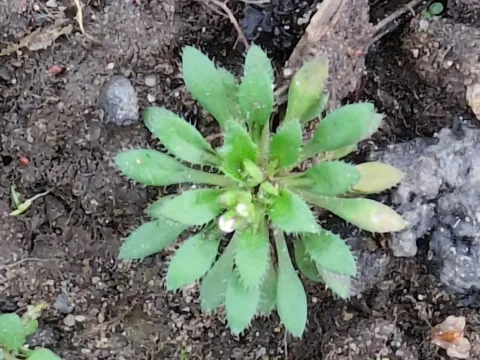
Whitlow-grass
Draba verna
Draba verna is a classic ephemeral plant that completes its life cycle in a very short period. In most agricultural settings, seeds germinate during the autumn months, forming a small basal rosette that survives the winter dormancy.
What the section contains
Whitlow-grass
Growth resumes immediately when soil temperatures begin to rise in early spring. Due to its rapid development, the plant finishes flowering and seed production within 4–6 weeks, often before primary crops enter their active growth phase.
This early-season cycle makes it a common feature in winter crop fields. Because it blooms so early, it can often mature and disperse seeds before standard spring field operations, such as mechanical weeding, are fully underway.
The seeds remain viable in the soil for several years. This robust seed bank ensures that the population persists even if environmental conditions are unsuitable in a given year for full development.
In terms of farm management, the most critical time to control Draba verna is during the late summer and autumn germination window. Controlling the rosettes early prevents the cycle from restarting in the following spring season.
Belonging to the Brassicaceae family, Draba verna is highly adaptable to various soil types. It is most commonly found on sandy, nutrient-poor, or disturbed soils where inter-species competition is minimal.
The plant has a high requirement for light and does not thrive in dense, healthy crop canopies. It predominantly colonizes gaps in vegetation, thin crop stands, or soil patches where the main crop has failed to emerge properly.
It is remarkably tolerant of low-fertility soils and can thrive in environments with low nutrient availability, making it an excellent colonizer of marginal lands or abandoned agricultural fields.
Draba verna prefers cool, moist spring conditions. High temperatures and prolonged drought typically trigger rapid senescence, leading the plant to dry out as soon as its seed capsules are fully developed.
To reduce its presence in fields, agronomists recommend maintaining high crop uniformity and ensuring adequate fertilization, which allows the target crop to outcompete this small ephemeral species for sunlight and space.
As a member of the mustard family, Draba verna can act as a secondary host for several pests that target commercial cruciferous crops, such as flea beetles and various species of aphids.
While the plant's lifespan is short, it can harbor spores of common pathogens like downy mildew and other diseases affecting brassicas, effectively serving as a disease bridge within the landscape.
Mechanical control of this species is difficult due to its small stature. In winter cereal crops, it rarely poses a significant yield threat; however, in specialty crops or young transplants, it can compete for early-season water and nutrients.
Chemical control is generally only effective if applied during the rosette stage. Once the stem begins to elongate, the plant becomes more resistant, and applying herbicides at this late stage is often inefficient.
Effective management focuses on long-term prevention through crop rotation and maintaining a dense canopy cover, which remains the most sustainable way to suppress the development of this ephemeral weed.