
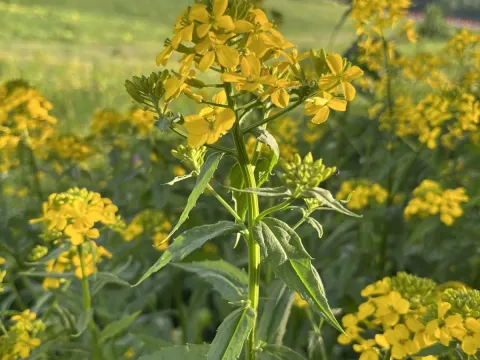
Yellow wallflower
Erysimum aureum
Erysimum aureum, belonging to the Brassicaceae family, is cultivated primarily for its medicinal properties. The sowing process is typically carried out in late autumn or early spring into well-prepared, friable soil to ensure optimal germination and seedling establishment.
What the section contains
Yellow wallflower
The seeds should be sown at a shallow depth of approximately 1 to 1.5 centimeters. Because the seeds are quite small, achieving good soil contact through light rolling after sowing is crucial for uniform field emergence and vigor.
A standard row spacing of 30 to 45 centimeters is recommended to facilitate mechanical weeding and ensure that the plants have adequate space to develop their vegetative biomass. Thinning should occur shortly after the emergence of true leaves.
Field density plays a critical role in yield performance; excessive density can promote disease outbreaks, while sparse stands lead to poor land utilization. Proper calibration of seeding machinery is essential for maintaining an ideal plant stand.
Early-season weed management is paramount, as the young seedlings of Erysimum aureum have a relatively slow initial growth rate and are sensitive to competition from aggressive weed species.
The yellow wallflower thrives in well-drained, sandy-loam or light soil types with a neutral to slightly alkaline pH. Proper soil aeration is vital for root development, and heavy clay soils should be avoided or amended with organic matter.
While the species is hardy and can withstand cool temperatures, it requires ample sunlight for vigorous growth. Shaded environments inhibit photosynthesis and lead to etiolated stems with reduced concentrations of bioactive compounds.
Water requirements are moderate, but consistent moisture is needed during the active rosette stage and initial stem elongation. Excess soil moisture, especially during the flowering stage, can lead to root rot and fungal infections.
Nutrient management focusing on phosphorus and potassium encourages stem strength and high-quality biomass production. Nitrogen application should be balanced to avoid excessive succulent growth, which may attract pests.
The site selection should prioritize open areas with good air circulation to minimize humidity-related diseases and maintain the health of the plant population throughout the growing season.
Yield productivity is heavily dependent on the precision of agronomic practices and the fertility level of the soil. On average, well-managed fields can yield approximately 1.5 to 2.0 tonnes of dried plant material per hectare.
The maximum concentration of heart glycosides is observed during the full flowering stage. Harvesting timing is critical; missing the optimal window results in a significant decline in the pharmaceutical quality of the harvested crop.
Mechanical harvesting methods are generally preferred for larger plantations, using sickle bars or cutters. Care must be taken to minimize dirt contamination, which affects the purity standards required for pharmaceutical processing.
Yield stability is supported by consistent crop rotation and the use of high-quality, certified seeds. Integrating modern agricultural techniques allows for a better realization of the plant's genetic potential.
Sustainable cultivation practices, including careful weed control and targeted moisture management, contribute to a high-quality product that meets the stringent requirements of the herbal medicine market.
Crucifer pests, such as flea beetles, are the primary threat during the emergence phase. These pests can cause significant damage to young plants, necessitating early monitoring and the use of approved insect control measures.
Aphid populations may develop during the stem elongation and flowering stages. These insects extract sap and weaken the plants, often leading to reduced yield and higher susceptibility to secondary infections.
Powdery mildew represents a common fungal threat when ambient humidity is high and airflow is restricted. Preventive measures, such as maintaining appropriate plant spacing, are the most effective management tools against this disease.
Root rot caused by soil-borne pathogens can impact the crop in poorly drained fields. Regular monitoring of the soil drainage and managing irrigation levels are essential steps in preventing the buildup of these pathogens.
Integrated pest management strategies, emphasizing crop rotation and field sanitation, are vital for reducing the reliance on chemical inputs and maintaining long-term soil health for Brassicaceae cultivation.
Harvesting should be conducted at the peak of flowering, as this corresponds to the highest levels of active pharmaceutical ingredients. Waiting until the seeds begin to set leads to a loss in medicinal value and vegetative mass.
The upper portions of the stems, up to 30 centimeters in length, are harvested. Rapid handling after the cut is essential, as the material is prone to rapid fermentation or spoilage if left in large, moist piles.
The drying process must be performed in shaded, well-ventilated areas or in controlled-temperature industrial driers. Keeping the drying temperature below 50 degrees Celsius is necessary to prevent the degradation of heat-sensitive compounds.
After reaching the appropriate moisture content, the dried material should be processed to remove any remaining weeds or debris. Maintaining purity standards is a prerequisite for achieving high market prices for the raw material.
Proper storage in cool, dry, and dark conditions ensures that the active glycoside content remains stable throughout the post-harvest period until the product is dispatched to pharmaceutical end-users.