
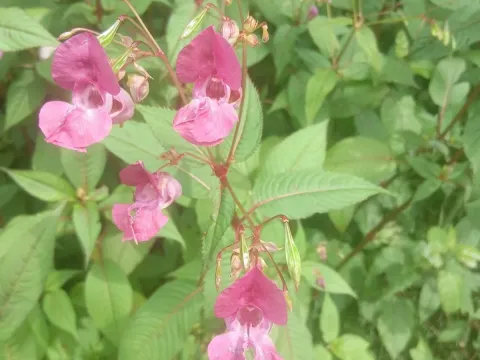
Impatiens
Impatiens L.
Impatiens seeds are typically sown indoors 8 to 10 weeks before the last expected spring frost to ensure strong transplants for the growing season.
What the section contains
 Broad-leaved balsam
Impatiens platypetala Lindl.
Broad-leaved balsam
Impatiens platypetala Lindl.
 Busy Lizzie
Impatiens walleriana Hook. f.
Busy Lizzie
Impatiens walleriana x Impatiens pseudoviola
Busy Lizzie
Impatiens walleriana Hook. f.
Busy Lizzie
Impatiens walleriana x Impatiens pseudoviola
 Congo cockatoo
Impatiens niamniamensis Gilg emend. G.M. Schulze
Congo cockatoo
Impatiens niamniamensis Gilg emend. G.M. Schulze
 Garden balsam
Impatiens balsamina L.
Garden balsam
Impatiens balsamina L.
 Himalayan balsam
Impatiens glandulifera Royle
Himalayan balsam
Impatiens glandulifera Royle
 Impatiens auricoma
 Baill.
Impatiens auricoma
Impatiens auricoma Baill.
 Impatiens flaccida
 Arn.
Impatiens flaccida
Impatiens flaccida Arn.
 Impatiens namchabarwensis
 R. J. Morgan et al.
Impatiens namchabarwensis
Impatiens namchabarwensis R. J. Morgan et al.
 Impatiens pseudoviola
 Gilg
Impatiens pseudoviola
Impatiens pseudoviola Gilg
 Impatiens radiata
 Hook. f.
Impatiens radiata
Impatiens radiata Hook. f.
 Impatiens repens
 Moon
Impatiens repens
Impatiens repens Moon
 Impatiens walleriana hybrid
Impatiens walleriana x repens
Impatiens walleriana hybrid
Impatiens walleriana x repens
 New Guinea Impatiens
Hybrids between Impatiens flaccida and Impatiens hawkeri
New Guinea Impatiens
Hybrids between Impatiens flaccida and Impatiens hawkeri
 New Guinea Impatiens
Impatiens hawkeri W. Bull
New Guinea Impatiens
Impatiens hawkeri x Impatiens platypetala
New Guinea Impatiens
Impatiens hawkeri W. Bull
New Guinea Impatiens
Impatiens hawkeri x Impatiens platypetala
 New Guinea Impatiens
Impatiens New Guinea Group x Impatiens auricoma
New Guinea impatiens
Impatiens New Guinea Group
New Guinea Impatiens
Impatiens New Guinea Group x Impatiens auricoma
New Guinea impatiens
Impatiens New Guinea Group
 Rough balsam
Impatiens scabrida DC.
Waller's hybrid impatiens
Impatiens walleriana x I. auricoma
Rough balsam
Impatiens scabrida DC.
Waller's hybrid impatiens
Impatiens walleriana x I. auricoma
Impatiens
Because the seeds require light to germinate, they should be lightly pressed into the surface of the soil rather than covered with a thick layer of media.
Maintaining a constant temperature between 22 and 25 degrees Celsius is critical for uniform germination and early development of the seedlings.
Once seedlings develop true leaves, they should be pricked out into individual containers to allow adequate space for root and foliage expansion.
Hardening off the plants is a vital step before moving them to their permanent location to acclimatize them to outdoor wind and light conditions.
Impatiens belongs to the Balsaminaceae family and originates from tropical regions of Africa and Asia, which dictates its high warmth requirements.
The plant thrives in partial shade, as intense direct sunlight often causes leaf wilting and reduces the overall visual quality of the flowers.
Proper soil management involves using a rich, well-draining potting mix that retains enough moisture to keep the succulents from drying out.
Regular irrigation is essential, but it must be balanced to prevent waterlogging, which often leads to severe physiological disorders and pathogen outbreaks.
In landscaping and commercial use, Impatiens is highly valued for its ability to provide continuous color in shaded areas where other plants fail to bloom.
The crop is highly susceptible to soil-borne pathogens such as Verticillium wilt, Rhizoctonia, and Pythium root rot, which are often triggered by overwatering.
Gray mold is another significant concern in humid conditions, frequently infecting flowers and foliage and rapidly spreading throughout dense plantings.
Viral infections, such as tomato mosaic virus and tobacco mosaic virus, represent serious threats that cause systemic stunting and foliar distortions.
The root-knot nematode is a notorious pest that induces gall formation on roots, drastically hindering water and nutrient uptake in affected plants.
Preventative measures, including strict sanitation, the use of disease-free soil, and consistent monitoring, are necessary to minimize losses in cultivation.