
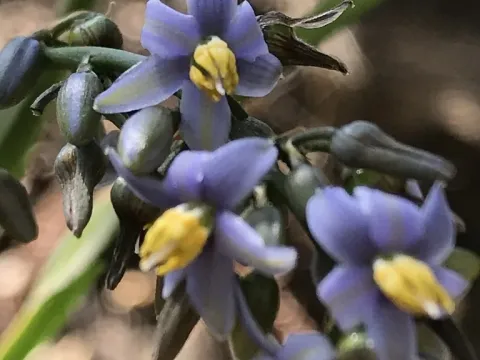
Dianella
Dianella
Dianella is a genus of perennial herbs belonging to the Asphodelaceae family. Native primarily to Australia, New Zealand, and various Pacific islands, this plant is well-regarded for its resilience and striking appearance in temperate and subtropical landscapes.
What the section contains
 Black-anther flax-lily
Dianella nigra Colenso
Black-anther flax-lily
Dianella nigra Colenso
 Blue Flax Lily hybrid
Dianella caerulea x Dianella brevipedunculata
Blue Flax Lily hybrid
Dianella caerulea x Dianella brevipedunculata
 Blue Flax-lily
Dianella caerulea Sims
Blue Flax-lily
Dianella caerulea Sims var. assera R. J. F. Hend.
Blue Flax-lily
Dianella caerulea Sims
Blue Flax-lily
Dianella caerulea Sims var. assera R. J. F. Hend.
 Dianella brevipedunculata
 R. J. F. Hend.
Dianella brevipedunculata
Dianella brevipedunculata R. J. F. Hend.
 Dianella congesta
 R. Br.
Dianella congesta
Dianella congesta R. Br.
 Dianella ensifolia
 (L.) DC.
Dianella ensifolia
Dianella ensifolia (L.) DC.
 Dianella intermedia
 Endl.
Dianella intermedia
Dianella intermedia Endl.
 Dianella longifolia
 R. Br.
Dianella longifolia
Dianella longifolia R. Br.
 Dianella prunina
 R. J. F. Hend.
Dianella prunina x Dianella revoluta
Dianella prunina x Dianella revoluta
Dianella prunina
Dianella prunina R. J. F. Hend.
Dianella prunina x Dianella revoluta
Dianella prunina x Dianella revoluta
 Dianella revoluta
 R. Br.
Dianella revoluta
Dianella revoluta R. Br.
 Dianella revoluta var. brevicaulis
Dianella revoluta R. Br. var. brevicaulis Ostenf.
Dianella revoluta var. brevicaulis
Dianella revoluta R. Br. var. brevicaulis Ostenf.
 Dianella tasmanica
 Hook.
Dianella tasmanica
Dianella tasmanica Hook.
 Hybrids of Dianella prunina and Dianella caerulea
Hybrids between Dianella prunina R. J. F. Hend. and Dianella caerulea Sims
Hybrids of Dianella prunina and Dianella caerulea
Hybrids between Dianella prunina R. J. F. Hend. and Dianella caerulea Sims
Dianella
Botanically, the plant is characterized by tufted, grass-like leaves that grow from rhizomes. It produces delicate panicles of blue or yellow flowers, followed by distinct, often glossy, blue or purple berries that remain on the plant for an extended period.
Dianella thrives in well-drained, fertile soil. It requires a balanced approach to moisture; while it has some drought tolerance once established, consistent watering during the growing season promotes better foliage density and overall plant vigor.
Regarding climate, the plant prefers sunny to partially shaded locations. It is not cold-hardy, meaning it is often grown as an indoor ornamental or a seasonal container plant in regions where temperatures drop significantly during winter.
The practical application of Dianella is predominantly in horticulture and landscaping. Its architectural form makes it an excellent choice for modern gardens, mass planting, and urban landscaping projects where low-maintenance aesthetic appeal is desired.
Root rot is the most significant threat to Dianella, usually caused by waterlogged soil conditions. Ensuring that the planting site or pot has excellent drainage is critical for preventing the development of fungal pathogens that attack the root system.
Common indoor and greenhouse pests, such as spider mites, mealybugs, and scale insects, may infest the leaves if the air humidity is too low. Monitoring the plant closely and maintaining appropriate environmental conditions are the best defenses against these pests.