
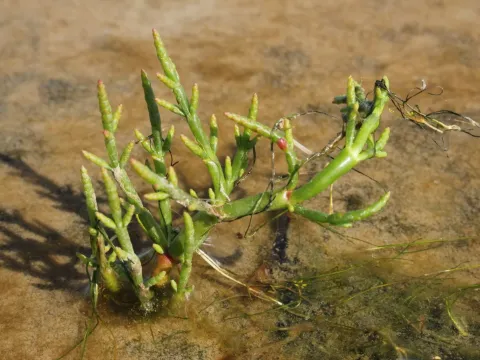
Sea asparagus
Salicornia maritima
Sowing sea asparagus is typically performed in the spring when soil temperatures reach stable positive values, usually between April and May. The seeds are highly viable but require consistent soil moisture levels to ensure uniform germination.
What the section contains
Sea asparagus
In natural habitats, reproduction occurs through self-seeding after the fruit ripens in late summer. In commercial farming, shallow surface seeding is practiced because the seeds are extremely small and require minimal soil coverage for successful emergence.
Sowing density depends on the production goal: green mass harvesting requires higher density compared to seed production. Proper spacing prevents competition between seedlings and promotes even development of the biomass throughout the field.
An important factor in sowing is controlling the salinity of the irrigation water. Although the plant is a halophyte, excessive salt concentrations during the initial germination phase can hinder development, so moderate irrigation is recommended at the start.
The crop shows excellent adaptability to changing environmental conditions, allowing for flexible sowing dates in regions with mild climates. Regular monitoring of seedlings allows for adjustments in agricultural practices during the early stages of vegetation.
Sea asparagus is a succulent halophyte belonging to the Amaranthaceae family, evolved to thrive in extreme salinity. The plant effectively absorbs salts from the soil solution, accumulating them in its fleshy stems, which is its defining characteristic.
Successful growth requires well-lit areas with open access to sunlight, as shading leads to a sharp decline in photosynthetic activity and stem degradation. The plant is highly light-demanding throughout its entire vegetative period.
Soil must be well-drained, preferably sandy or silty loam with a high sodium content. The plant does not tolerate standing fresh water, so effective drainage is crucial to prevent root rot in non-saline conditions.
Climatic requirements include high summer temperatures, which promote the intensive accumulation of oils and other bioactive substances. In temperate climates, the growth rate may be slower, but the plant maintains its high viability.
The crop does not require traditional nitrogen fertilizers, as it competes successfully on poor, saline soils where other crops fail to survive. This efficiency makes it a cost-effective and environmentally friendly option for saline lands.
Yield of sea asparagus varies depending on soil salinity and moisture availability. With optimal agricultural management, the plant forms significant volumes of succulent biomass suitable for the food and processing industries.
Oil extraction from seeds is a promising area of use, as sea asparagus provides stable yields on marginal lands. The content of fatty acids in the seeds is comparable to traditional oilseed crops while requiring fewer resources.
The biomass is rich in minerals and micronutrients, making it a valuable raw material for functional supplements. Quantitative yield depends directly on the plant density per unit area.
Yield potential can be increased through drip irrigation with saline water, which provides the plant with nutrients in an accessible form. This allows for the transformation of unused saline territories into productive agro-systems.
Economic efficiency is determined not only by total biomass weight but also by the possibility of integration into aquaculture systems. This model allows for dual production benefits from a single plot of land.
Sea asparagus possesses high resistance to diseases due to its specific biochemical composition and the ability to accumulate salts. High sodium concentration in its tissues creates an inhospitable environment for most phytopathogens.
Major pests include specialized insects that have adapted to feed on halophytes. While some beetle species may cause damage to stems, these instances are rare and usually do not result in significant yield losses when proper care is provided.
Disease issues are more likely to occur in greenhouses if temperature or humidity regimes are violated. In open fields, the crop usually does not require chemical protection, making it a naturally organic-friendly product.
Weeds pose almost no threat to sea asparagus, as most standard weed species cannot survive in the high-salinity conditions required for this crop. This simplifies field management significantly and removes the need for herbicides.
Regular visual inspection is the best form of prophylaxis. Monitoring plant health helps identify early deviations in development that might be related to nutrient imbalances or water management issues in the soil.
Harvesting for green mass is performed during the active vegetative growth phase, before the plant begins to flower and accumulates fiber. Depending on the scale, harvesting can be done manually or via mechanized equipment.
When harvesting for seeds, it is necessary to wait for full maturity, when the plant turns a reddish-brown color. At this stage, oil content reaches its peak, and seed moisture content decreases to optimal levels for processing.
Post-harvest biomass requires rapid primary processing to prevent spoilage and maintain nutritional quality. Drying or freezing are standard methods for preserving raw materials for subsequent processing.
Cleanliness of the harvested product is crucial; therefore, mechanized harvesting requires precise equipment settings to minimize soil contamination and debris. This ensures a high-quality end product for the market.
The crop is used in the culinary industry as a natural salt substitute or vegetable supplement. Additionally, the potential for using sea asparagus biomass as a feedstock for biofuels is currently under investigation, highlighting its future importance.