
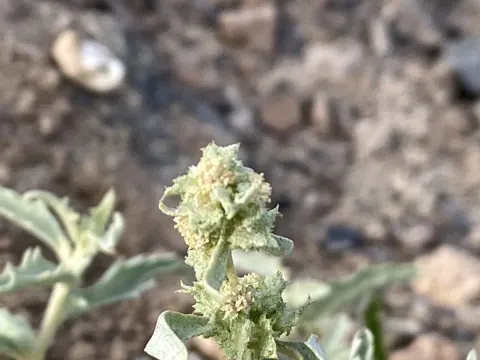
Semilunar saltbush
Atriplex semilunaris
Sowing of Atriplex semilunaris should be conducted in well-warmed soil, typically late spring, once the risk of late frosts has passed. Choosing the right time ensures uniform germination and strong early development.
What the section contains
Semilunar saltbush
The seeds are sown in rows, with spacing carefully planned to facilitate future cultivation and weeding. Due to the small size of the seeds, the depth of sowing should be shallow, usually not exceeding 1–2 centimeters.
Optimal planting density is crucial to ensure that each plant receives sufficient sunlight and nutrients, promoting uniform canopy development. Proper spacing also facilitates better airflow around the plants.
Compacting the soil after seeding is recommended to ensure better contact between the seed and the moist soil layers. This practice is essential for success in dryland conditions where soil moisture is limited.
If producing seed for future crops, the sowing schedule may be adjusted to provide the longest possible growing season, ensuring that all plants reach full physiological maturity.
Atriplex semilunaris is a hardy halophyte belonging to the Amaranthaceae family. It is renowned for its exceptional ability to thrive in saline environments where conventional agricultural crops would typically fail.
The plant demonstrates remarkable drought resistance, making it an ideal candidate for cultivation in arid regions. It withstands extreme heat and high solar radiation without suffering significant biomass loss.
This crop is not demanding regarding soil quality, successfully growing on rocky, sandy, or alkaline substrates. It excels in well-drained soils where oxygen availability to the root system is maintained.
It tolerates irrigation with high-salinity water, offering a sustainable solution for the reclamation of degraded or saline lands. The plant is strongly photophilous, requiring full exposure to sunlight for optimal growth.
The biological resilience of this species allows it to be grown with low-input agricultural methods, reducing the need for intensive fertilization and chemical support throughout the season.
The biomass yield of the semilunar saltbush varies depending on water availability and general management practices. Under optimal growing conditions, it produces a substantial volume of green matter.
Dry matter output is the primary metric for economic efficiency. The best time for harvest is usually the budding stage, when the nutritional profile, including crude protein and mineral content, is at its peak.
While the plant is highly resilient, supplemental nitrogen fertilization during the early stages of growth can significantly enhance the total biomass yield, particularly in the first year of establishment.
In dryland conditions, while the overall yield may be lower than under irrigation, the crop remains reliable even in drought years. Its ability to regenerate after cutting allows for multiple harvests in a single season.
When producing seeds, management should focus on limiting excessive vegetative growth during the late season to ensure all energy is directed toward grain maturation and yield stability.
Atriplex semilunaris possesses high natural resistance to most common diseases affecting conventional field crops. Its physiological specialization helps it avoid many standard fungal and bacterial pathogens.
Soil-borne pests may pose a threat during the initial seedling stage, especially if crop rotation protocols are not strictly followed. Regular scouting of the field is necessary during the first few weeks of growth.
Sucking insects, such as aphids or spider mites, may sporadically colonize the crop during prolonged periods of drought. Monitoring and intervention are required only if pest populations reach economic thresholds.
Weed competition can be significant during the early development stage, but timely cultivation or mechanical inter-row weeding usually addresses this issue effectively without the need for herbicides.
Water-related diseases, such as root rot, are rare in this species, as it is physiologically adapted to thrive in environments with specific water and salt balances that prevent common soil pathogens.
The harvest of green biomass is typically performed using forage harvesters or mowers during the active growth phase. This ensures the collection of high-quality forage rich in essential nutrients for livestock.
After cutting, the material must be dried properly to prevent mold development during storage. Preserving the leaves is critical, as they hold the majority of the plant's protein and mineral values.
Silage production is a viable option for storing the surplus biomass, as the plant ferments well under anaerobic conditions. It can be mixed with other forage crops to improve the overall feed quality.
Seed harvest should take place only after complete maturation. It is essential to monitor the moisture content of the seeds to ensure safe and successful long-term storage in agricultural warehouses.
Leaving the root system in the soil after harvest contributes to improved soil structure and significantly reduces the risk of wind and water erosion on vulnerable, arid agricultural land.