
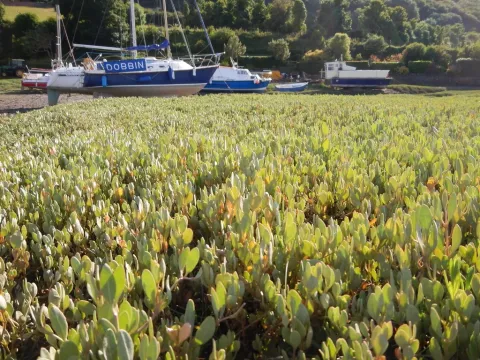
Sea purslane
Atriplex portulacoides
Sowing sea purslane is most effective during early spring, once the soil temperatures have risen sufficiently to support consistent germination.
What the section contains
Sea purslane
Seeds should be sown shallowly, as they require minimal covering to thrive, and they need a substrate that remains consistently moist during the establishment phase.
In commercial settings, direct drilling into saline soil is common, though greenhouse propagation followed by transplanting ensures higher survival rates in challenging conditions.
It is crucial to ensure that the sowing depth does not exceed two centimeters, as deeper burial can prevent the seedling from reaching the surface.
Providing a light mulch or shade during the initial days after sowing can help protect the young shoots from drying out in coastal winds.
Sea purslane is a perennial subshrub from the Amaranthaceae family, highly adapted to saline environments such as salt marshes and coastal mudflats.
It thrives in full sunlight and requires soils with high concentrations of sodium chloride, where it utilizes specific glands to manage salt levels internally.
Soil structure should allow for good drainage, as although the plant tolerates tidal flooding, it does not perform well in permanently stagnant freshwater environments.
The ideal climate is maritime, with mild winters that protect the woody stems from freezing, though it is notably hardy compared to other non-halophytic plants.
Agronomic management focuses on maintaining the correct salinity levels, as the plant relies on these salts for optimal physiological performance.
The yield of sea purslane is determined by the salinity level of the growing medium and the availability of essential nutrients in the silt or sand.
Multi-harvest strategies are common, as the plant responds well to regular cutting, producing a flush of new growth shortly after harvesting the edible shoots.
Productivity levels are generally high in ideal coastal conditions, making it an excellent candidate for sustainable farming on otherwise unproductive saline land.
Regular pruning encourages denser foliage growth, which significantly increases the total volume of usable green biomass per hectare.
Yield stability over several seasons is a key trait of this plant, provided the soil moisture and mineral balance remain within the tolerated range.
This crop is remarkably resistant to most common agricultural pests and diseases, largely due to its unique salt-accumulating metabolism.
Aphids can occasionally colonize young growth during periods of stress, but they rarely cause significant economic damage to established populations.
Fungal issues such as root rot can occur if the field is poorly managed with excessive stagnant freshwater irrigation or lack of proper soil aeration.
The main threats to successful cultivation are environmental, such as extreme frosts or sudden changes in salinity that the crop cannot rapidly acclimate to.
Implementing a proper crop rotation or fallow period can help manage the long-term soil health, although this is seldom required for a halophyte.
Harvesting sea purslane is best performed by trimming the tips of the shoots, which are the most tender and desirable parts for culinary use.
For large-scale agricultural production, mechanical harvesting machinery can be adapted to ensure a uniform cut that promotes rapid regrowth.
Post-harvest management involves immediate cooling to preserve the crispness of the leaves, as they are susceptible to wilting in warm, dry environments.
Seed collection is performed at the end of the season once the inflorescences become dry and brown, ensuring the seeds are fully mature for high viability.
Efficient timing of the harvest ensures a continuous supply of high-quality biomass while allowing the plant sufficient time to recover and prepare for winter.