
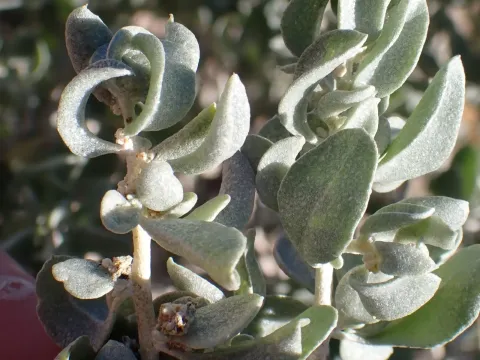
Shadscale
Atriplex confertifolia
Shadscale (Atriplex confertifolia) is a perennial shrub belonging to the Amaranthaceae family, widely recognized for its extraordinary ability to thrive in the arid deserts of North America. It is a dominant species in many cold desert ecosystems, displaying extreme salt and drought tolerance.
What the section contains
Shadscale
The plant grows best in well-drained, alkaline, or saline soils that are inhospitable to most other crops. Its success is attributed to a deep taproot that accesses moisture from deeper soil layers, allowing it to survive prolonged dry spells.
Botanically, shadscale is identified by its grayish, scaly leaves which help conserve water by reflecting intense sunlight. This structural adaptation, known as succulence in some forms, prevents dehydration and maintains cellular turgor even during peak summer temperatures.
In terms of agricultural management, the plant requires little to no irrigation, making it a sustainable choice for revegetation projects in degraded, high-salinity landscapes. It prefers full sun exposure to maintain its characteristic compact, mound-like growth form.
Economically, shadscale is highly valued as a late-season forage plant for livestock and wildlife. Its seeds and leaves provide essential nutrients during winter, serving as a reliable survival food when other vegetation is scarce.
The primary health threats to shadscale include various root rots that occur when environmental conditions promote excessive soil moisture, leading to hypoxic stress in the root zone.
Insect pests, specifically foliage-feeding beetles and certain species of mites, can cause significant defoliation, particularly in young, underdeveloped stands of the shrub.
Overgrazing remains the most significant threat to the longevity of shadscale populations. Continuous grazing pressure prevents the shrub from accumulating energy reserves, ultimately leading to mortality.
Invasive weed species often outcompete young seedlings, which grow quite slowly during their first year. Establishing a new stand requires careful management of competing vegetation in the early stages.
Climatic variability, characterized by shifting precipitation patterns, can interfere with the natural seed bank cycle, leading to reduced recruitment of new individuals in native stands.