
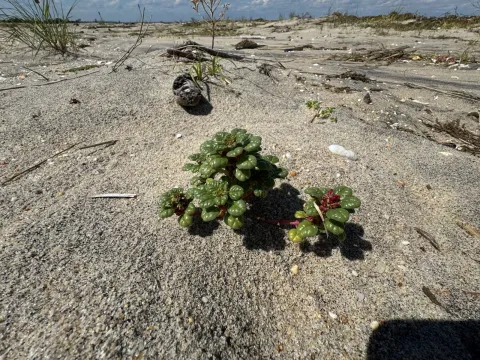
Sand amaranth
Amaranthus pumilus
Sand amaranth (Amaranthus pumilus) is an annual herbaceous plant belonging to the Amaranthaceae family. It is distinct due to its low-growing, prostrate habit, which is an adaptation to harsh coastal environments.
What the section contains
Sand amaranth
The species is native to the Atlantic coast of the United States. Its natural habitat includes sandy beaches and dunes, where it thrives in shifting sands exposed to salt spray and high-intensity sunlight.
Botanically, Amaranthus pumilus exhibits dense pubescence on its leaves and stems. This physical trait helps the plant retain moisture and protects it from the abrasive effects of wind-blown sand particles.
The soil requirements are strict: the plant necessitates deep, well-drained sandy substrates. It has low tolerance for high organic content or moisture retention, which makes it unsuitable for standard agricultural soils.
Regarding climate, the species requires a temperate coastal environment with high solar radiation. It is highly sensitive to shading, which significantly suppresses its germination and overall vegetative development.
Habitat loss is the primary threat to the survival of Amaranthus pumilus. Coastal development, dune stabilization, and heavy human traffic on beaches have severely restricted its native range.
In terms of pathology, the plant is susceptible to fungal infections in environments with poor air circulation. Root rot is a common issue when soil moisture levels exceed the plant's limited tolerance capacity.
Insects and certain larvae that feed on foliage pose a significant risk to young seedlings. Effective management requires manual monitoring, as chemical interventions are often incompatible with the plant's sensitive ecosystem.
Invasive plant species are a major competitor for the sand amaranth. These invaders often outgrow the native Amaranthus pumilus, depriving it of essential light and soil nutrients required for survival.
Extreme weather events, including hurricanes and storm surges, pose existential threats by physically destroying habitats. The rarity of the species makes it a priority for conservationists across its historical range.