
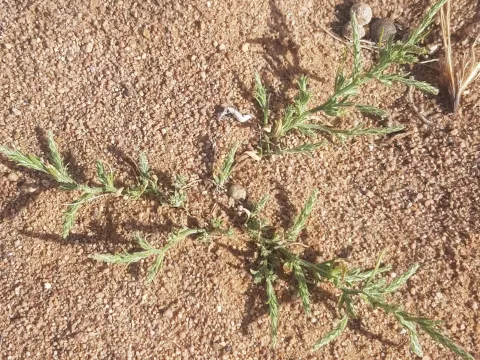
Oriental Bugseed
Corispermum orientale
Oriental bugseed (Corispermum orientale) is an annual herbaceous plant belonging to the Amaranthaceae family. This species is evolutionarily adapted to environments characterized by intense solar radiation and recurring water scarcity.
What the section contains
Oriental Bugseed
Seeds require warm soil conditions for effective germination. In temperate regions, sowing should be scheduled for late spring, once the risk of ground frost has completely subsided and soil temperatures are consistently favorable.
Planting should be done at a shallow depth of 1 to 2 centimeters. Because the seeds are tiny and possess limited nutrient reserves, deep burial significantly reduces the emergence rate and weakens the initial growth of seedlings.
The species exhibits rapid early-stage development, which allows it to establish quickly in the field. This vigor helps the crop outcompete opportunistic weed species during the critical first weeks of the growing season.
Proper plant density is essential for maximizing biomass. Overcrowding can lead to stunted growth, so precision sowing is recommended to ensure each individual plant has adequate access to sunlight and soil nutrients.
Oriental bugseed thrives in light, sandy, or loamy soils. It has a low tolerance for heavy clay or poorly drained soils, where root system respiration is restricted, often leading to rapid plant decline and death.
The plant is highly drought-tolerant and handles high temperatures exceptionally well. It remains productive even in arid climates where moisture-sensitive crops would fail, making it a potential candidate for sustainable agricultural use in dry regions.
It does not have high fertility requirements. While it grows satisfactorily on nutrient-poor soils, moderate applications of nitrogen during the vegetative phase can significantly enhance the volume of green mass harvested.
Optimal development depends on long daylight hours and high mean daily temperatures. Heat is a catalyst for metabolic processes in the plant, supporting both rapid stem elongation and the maturation of the seeds.
The soil pH should ideally be neutral or slightly alkaline. Extremely acidic conditions can negatively affect plant metabolism and overall yield, so soil testing prior to planting is a recommended practice.
The primary agricultural interest in oriental bugseed lies in its potential as a forage supplement in harsh environments. Its green biomass can be utilized in livestock rations, particularly in areas where traditional fodder crops face growth limitations.
Yield depends heavily on the harvest timing. The nutritional profile—including protein and carbohydrate concentration—is highest during the budding stage, just before the plant shifts its energy toward seed production.
The species is remarkably productive in terms of seed output. A single plant can produce thousands of seeds, ensuring the potential for rapid expansion and making it a highly reproductive crop that is easy to propagate across large areas.
To maximize biomass, mowing should be performed before the plant becomes lignified (woody). Timely cutting can sometimes trigger secondary growth, allowing for multiple harvests within a single growing season under irrigation or favorable moisture conditions.
Research indicates that when grown under optimal conditions, this crop can provide stable biomass yields that serve as a reliable safety net for farmers operating in volatile, drought-prone agricultural environments.
Oriental bugseed possesses natural resilience against many common agricultural pests and diseases. Its tough, often pubescent foliage acts as a physical barrier against several typical herbivorous insects.
The most significant threat is root rot, which is almost exclusively associated with waterlogged conditions. Selecting well-drained fields is the primary strategy for avoiding this pathology and ensuring crop health.
Pest pressure is generally low. While locusts or other dry-land insects may occasionally browse on the leaves, they rarely cause economic damage at a scale that would necessitate the application of insecticides.
Integrated pest management should focus on maintaining a clean field border to prevent the colonization of the crop by generalist pests that may harbor viruses from nearby weeds.
Due to its high resistance and adaptability, the plant is a low-maintenance candidate for ecological farming and does not typically require the regular application of chemical fungicides or pesticides.
Harvesting for forage should occur before the plants reach full seed maturity. At this stage, the stems retain their succulence, and the leaves maintain higher nutritional value compared to the more fibrous, matured stalks.
For seed production, harvesting is timed for physiological maturity, when the upper parts of the plant turn a straw-yellow or brownish color. It is critical to harvest promptly to avoid loss due to natural seed shattering.
When using mechanical harvesters, air flow settings must be carefully calibrated. Because bugseed seeds are extremely light, high fan speeds in the combine will result in the loss of the yield through the chaff outlet.
Post-harvest, seeds must be dried to a moisture content of approximately 12% for stable storage. Drying should occur in a shaded, well-ventilated area to prevent heat damage to the embryos, which would reduce germination rates.
Proper cleaning of the seed lot after harvest ensures the removal of debris and weed seeds. High-quality seed management is the foundation for achieving consistent plant stands in the following agricultural season.